
Ethereum's L2 hasn't been very successful. Data from L2Beat shows that prominent L2s like Arbitrum and Base handle around 90% of all Ethereum scaling traffic, while smaller or newer L2s struggle with low engagement.
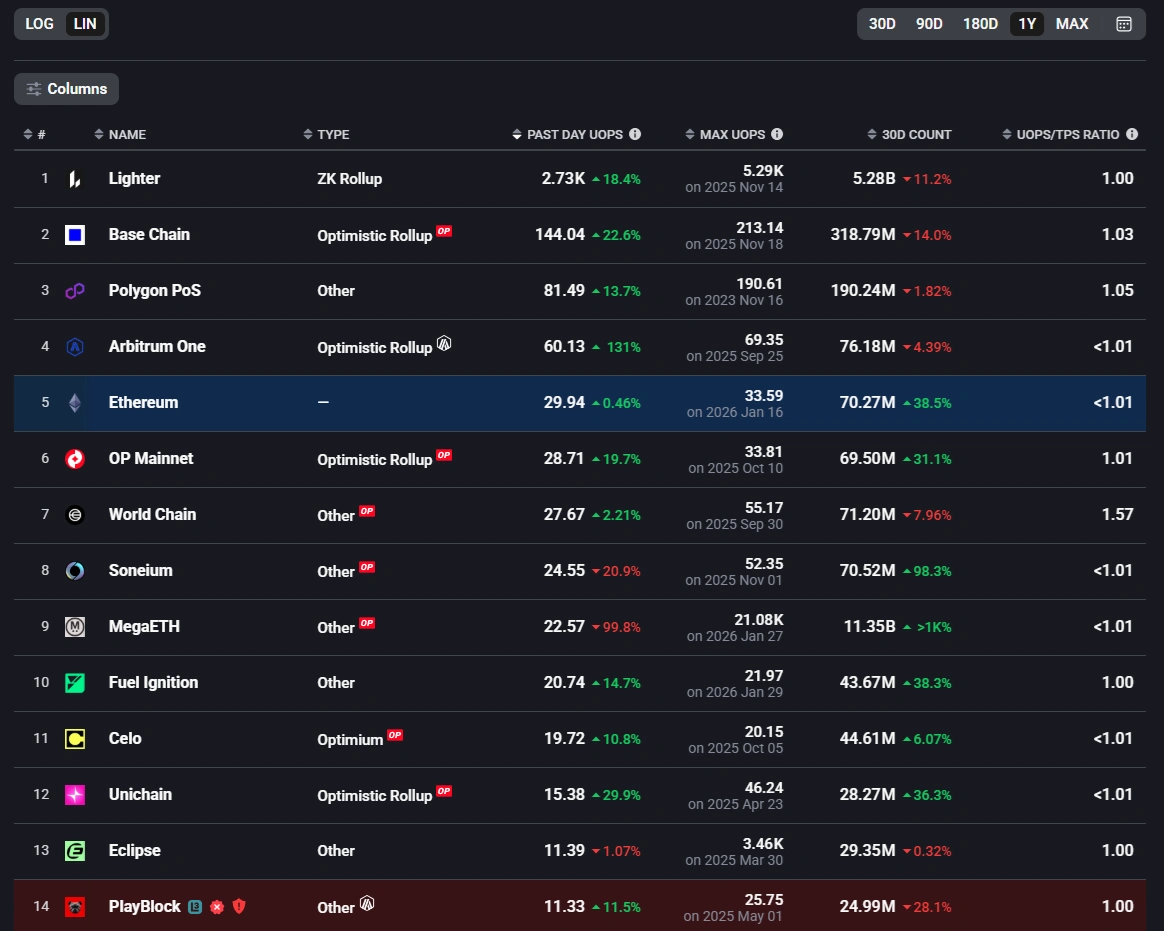
According to data from L2Beat, which tracks about 136 projects, only about 27 projects are currently averaging at least 1.00 UOPS (user operations per second) per day.
This means that around 109 projects are currently recording less than 1 UOPS. Therefore, the total ecosystem scaling factor is high, almost 97x, and the throughput can be attributed to a small group of highly active chains. On the other hand, more than 80% of the 135+ tracked projects endure negligible daily traffic (less than 1 user interaction per second).
Source: L2Beat
Ethereum L2 reports overwhelming user activity
The Ethereum ecosystem was split into two, with L1 serving as the global vault and L2 becoming the retail floor. This impacted metrics such as user activity and transaction volume.
Recent reports show that L2 is lagging behind in total locked value and daily user activity. Ethereum currently has a TVL of approximately $68 billion, and the combined TVL of all L2s is approximately $50 billion.
Daily users are also divided into top L2s such as Arbitrum and Base. Therefore, while the top L2s are attracting most of the liquidity and users, newer and less popular ones remain inactive.
Base in particular has emerged as a consumer-friendly hub, often handling more everyday users than L1 itself. The biggest reason for this is that the mainnet is attracting users again due to a major change in the pricing structure.
This difference is thanks to the Dencun and subsequent Pectra/Fusaka upgrades, which fundamentally changed the pricing relationship and resulted in much lower prices on mainnet.
Of course, Ethereum L2 is not completely losing out, and the most dramatic difference is seen in transaction throughput, with L2 currently processing millions more transactions per day than Ethereum.
According to L2 beatthe ecosystem scaling factor also reaches a record high, with L2 handling more than 20,000 TPS days during bursts, while L1 remains stable at the structural limit.
What does Vitalik Buterin think about their recent breakup?
The current performance of L2 on Ethereum has also been noted by founder Vitalik Buterin.
As far as he is concerned, “the original vision of L2 and its role in Ethereum no longer makes sense and a new path is needed.”
“L1 does not need L2 to be a 'branded shard,' because L1 scales itself. And L2 cannot and will not meet the characteristics that a true 'branded shard' requires,” he wrote to X.
Vitalik acknowledged that Ethereum itself is currently expanding directly on L1, with significant increases in gas limits planned for this year and the coming years. He believes a natural step is to stop treating L2 as a “branded shard” of Ethereum, and instead treat it as a full spectrum.
In his post, he also outlined what could be next for L2 looking to stay visible and relevant, such as refocusing on adding value and maintaining higher standards than L1, or supporting maximum interoperability with Ethereum.
“It's really each L2's choice what it wants to build. Don't just 'extend L1,' think about adding something new,” Vitalik writes.
How did the bottom two major countries react to Vitalik's rhetoric?
Vitalik’s story that L2’s rollup-centric vision was no longer a fit has since spread among crypto circles, with key L2 leaders sharing their own opinions in response.
Steven Goldfeder, co-founder of Offchain Labs, the company behind Arbitrum, said: answered In a long thread, he agreed with some of Buterin's assessments, even as he disagreed with downplaying the scale-up.
According to him, even with a high gas limit, the Ethereum mainnet cannot realistically handle thousands of TPS at peak times without sacrificing decentralization or cost.
Karl Froesch, co-founder of Optimism, I support Although we view L2 as full spectrum, we emphasized the need for a modular design. Floersch agreed that L2 needs to move beyond being a cheap Ethereum clone and either maintain its position or innovate to become less prominent.
He also seems to treat this statement as a challenge to optimism. claim The network is already close to becoming a reality.
bassist jesse pollack echoed This sentiment acknowledges that scaling L1 is positive for the entire ecosystem, and that L2 needs to showcase more unique features to stand out. He claims that Base focuses on those differences to stay relevant, which is consistent with Buterin's suggestion.
Alex Glukhov of Zksync agreed Along with Buterin, he made the case clearly, arguing that L2s who want to be of value in the future must learn to “specialize.” Meanwhile, Starkware's Eli Ben-Sasson said: hinted ZK-native L2s like Starknet are already on the path to specialization that Buterin describes.


