


The South African Reserve Bank believes there is no need for a central bank digital currency in the short term, arguing instead that the country should modernize its payments system.
The South African Central Bank said in a document released on Thursday that while the introduction of a retail CBDC is technically possible, there is no “strong immediate need”.
He said existing efforts remain an immediate priority, including programs to modernize payment systems and expand non-bank participation in national payment systems.
“While SARB does not currently support the introduction of retail CBDCs, we will continue to monitor developments and stand ready to act if the need arises.”
The central bank said it will continue to monitor developments in retail CBDCs while shifting its focus to exploring efficiencies in wholesale CBDC applications and cross-border payments.
Central banks issue warning on cryptocurrencies and stablecoins
The study investigated whether retail CBDCs could address the gaps in South Africa's payments system and found that challenges remain, as approximately 16% of adults remain unbanked.
He said that for a CBDC to be successful, it will need to match or exceed the benefits of cash, including offline capabilities, wide acceptance, low cost, ease of use, and privacy features.
South Africa has recently come out against cryptocurrencies, with the central bank issuing a warning about cryptocurrencies and stablecoins.
In a report released earlier this week, the SARB singled out “crypto assets and stablecoins” as a new risk for technology-enabled financial innovation.
The bank also warned that virtual currencies could be used to circumvent exchange control regulations that control the flow of funds into and out of South Africa.
CBDC race continues around the world
According to the Atlantic Council CBDC Tracker, only three countries have officially launched CBDCs: Nigeria, Jamaica, and the Bahamas.
There are 49 countries that have CBDCs in the pilot testing stage, 20 countries that are actively developing them, and 36 countries that are researching CBDCs. Meanwhile, the United States shelved its CBDC plan under the Trump administration.
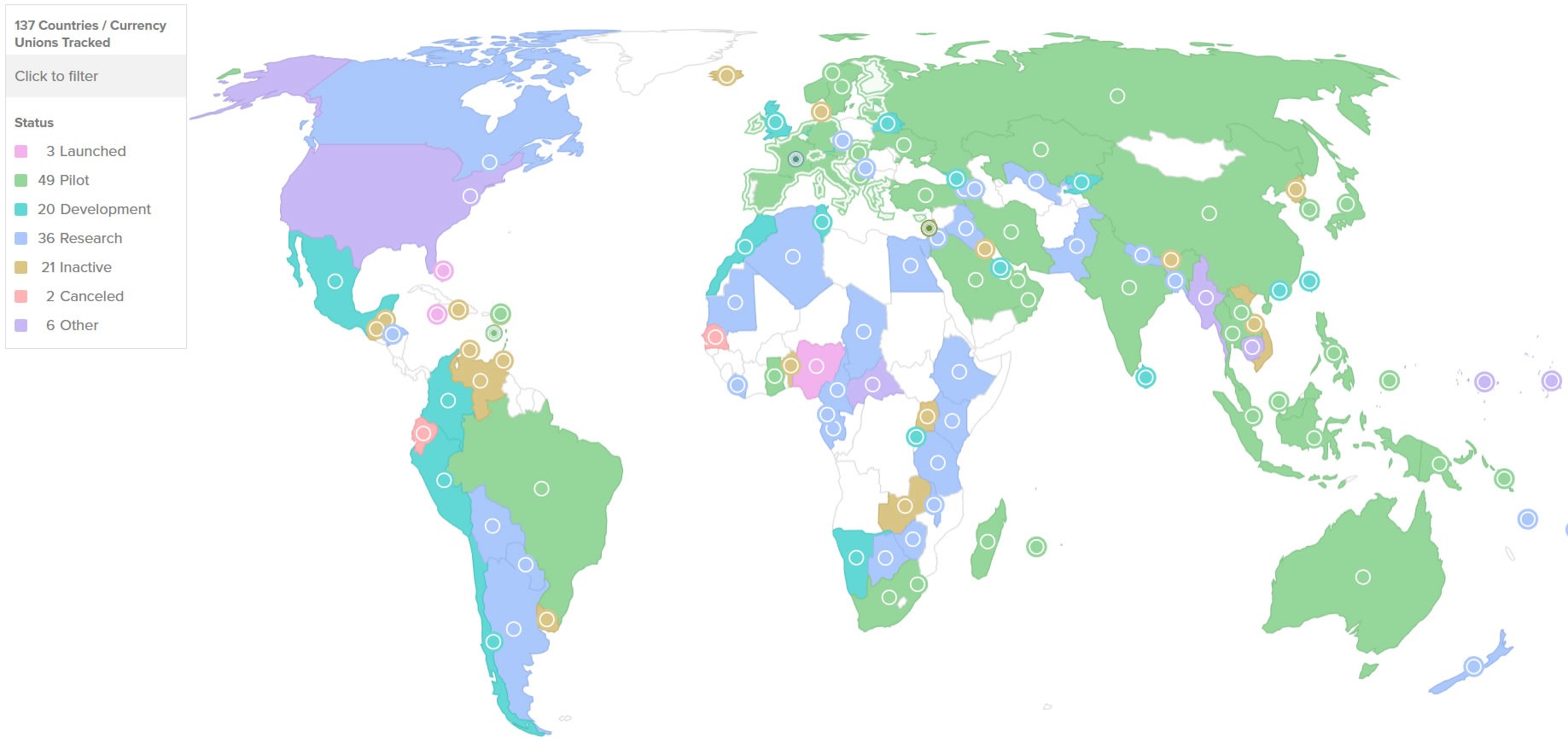
The CBDC race continues around the world. Source: Atlantic Council


