

Bitcoin has recorded three consecutive difficulty reductions, and despite the squeeze on miner revenues, the network's computing power remains strong above the 1.1 Zettahash/second (ZH/s) mark.
Bitcoin hashrate holds line with third difficulty drop, returns remain tougher than ever
Miners were able to prevent the network from falling below a threshold of 1 ZH/s (equivalent to 1,000 exahashes per second of total hashrate). As of this weekend, the total hashpower is holding steady at 1,125.48 EH/s. This increase follows a slight 0.74% difficulty adjustment recorded this week at block height 927360.
Bitcoin miners have experienced three difficulty declines since November 12th, but the total decline of 5.06% is less than the 6.31% increase recorded on October 29th at block height 921312. Still, hashrate shows little sign of easing, and its persistence is accelerating block production. According to data from December 13th, the average block interval is now 9 minutes and 25 seconds.
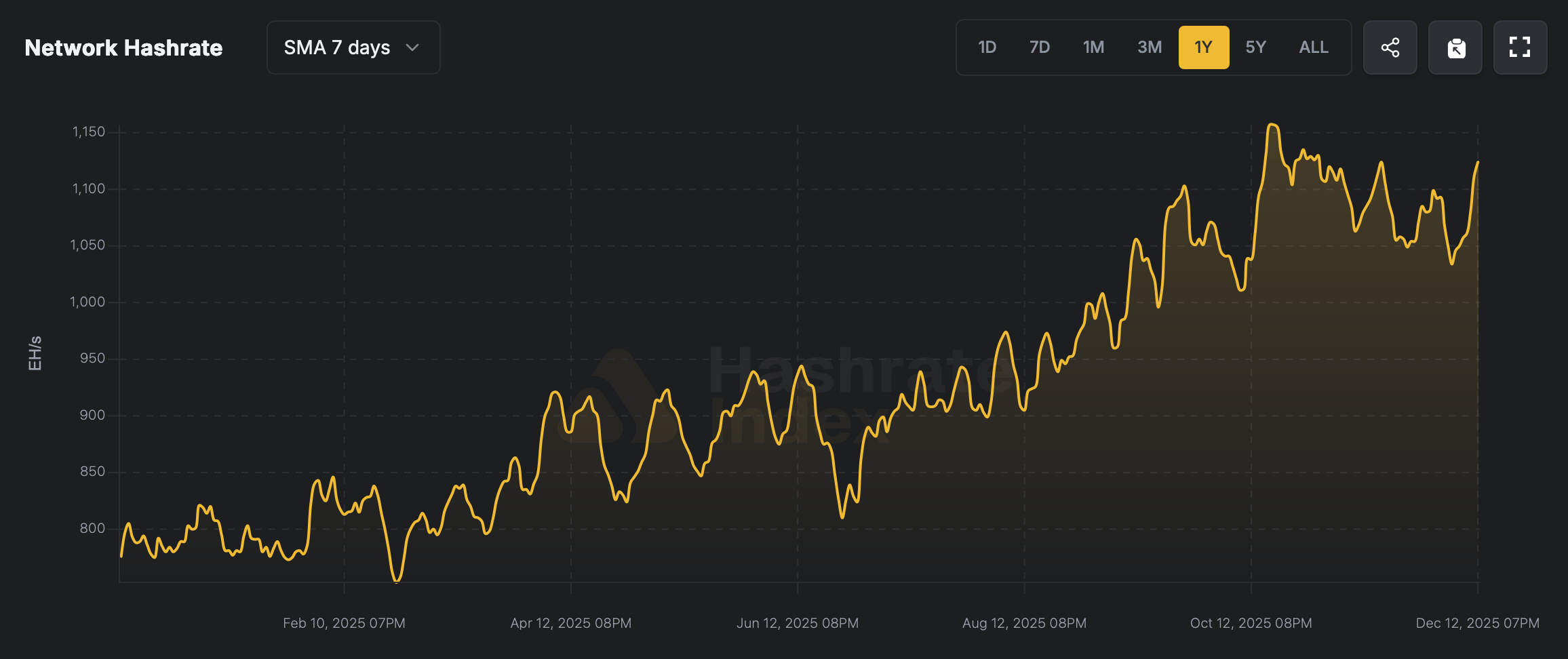
Bitcoin total hashrate as of December 13, 2025 (via hashrateindex.com).
As a result, the next difficulty epoch is expected to trend upwards, but there is still some distance to go, with only 18% (369 of 2,016 blocks) completed so far, leaving plenty of room for final adjustments to deviate from the current prediction of an increase of 6% or more. In particular, hash rates and block intervals are increasing, even though miners' incomes are still low.
read more: Google Trends data shows Bitcoin quietly holding its ground as the year ends
The hash price, or expected value of hash rate for 1 petahash, is 9.85% lower than it was 30 days ago, on November 13, 2025. At that time, it was $42.70 per petahash per second (PH/s) and is currently trading at $38.49. This reflects the softening of Bitcoin prices and the fact that on-chain fees currently make up a small portion of block rewards.
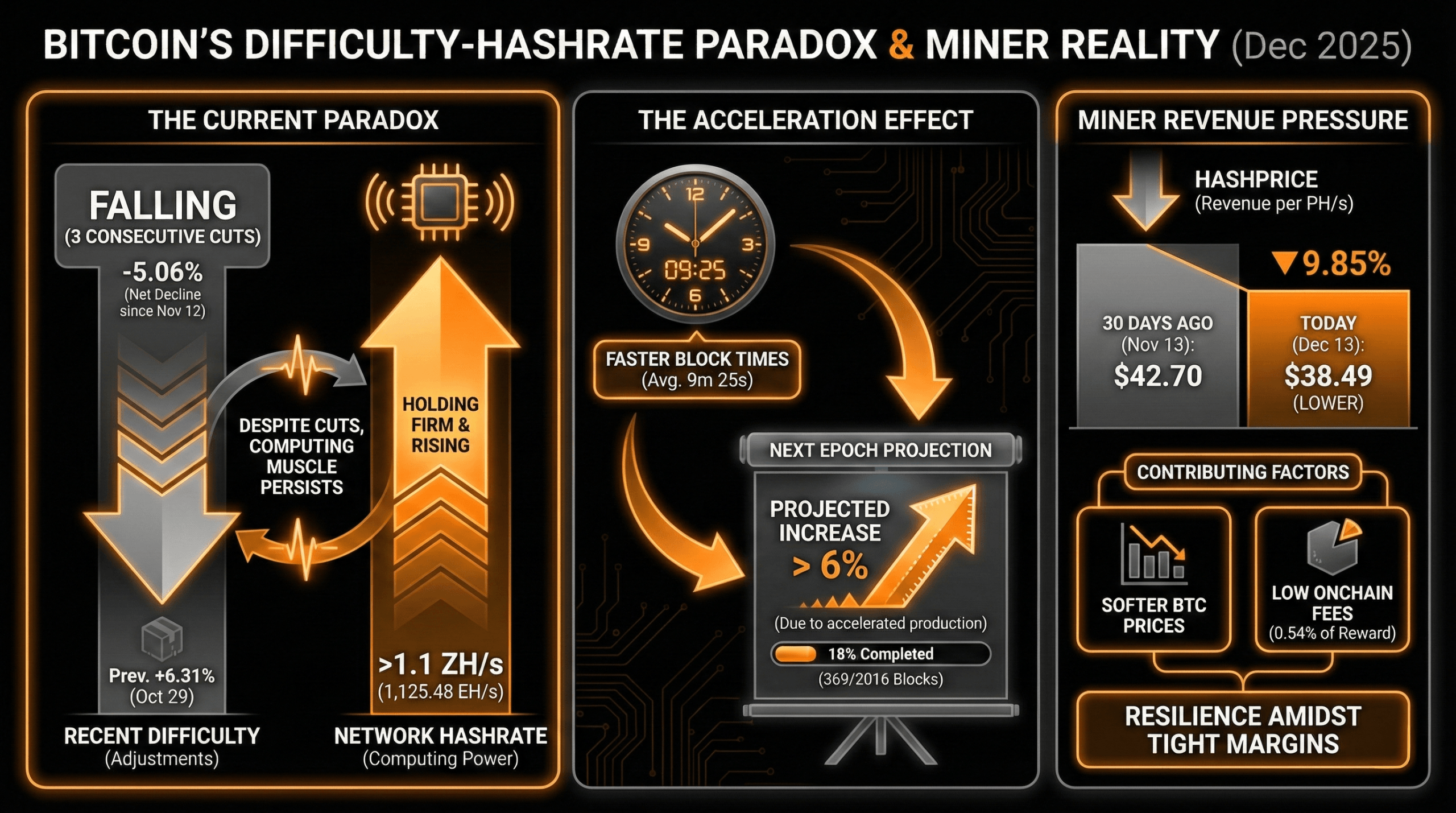
According to data from Luxor’s hashrateindex.com over the past 24 hours, on-chain fees are well below the 1% threshold, accounting for only 0.54% of block rewards during the period. Still, miners are once again showing resilience, a reminder that this kind of pressure is by no means unchartered territory. Only time will tell whether the pricing situation improves for miners or whether they face further burdens as 2026 begins.
Frequently asked questions ⛏️
- What is Bitcoin's current network hashrate? Bitcoin's total hashrate is measured to be over 1.1 zettahashes per second, and its total hashpower is approximately 1,125.48 exahashes per second.
- Why has Bitcoin difficulty decreased recently? Bitcoin difficulty has decreased three times since November 12 due to changes in mining conditions, even though the overall network hashrate remains elevated.
- How fast are Bitcoin blocks being generated currently?As of December 13th, the average block time is running at approximately 9 minutes and 25 seconds, exceeding our goal of 10 minutes.
- Why will Bitcoin miners face revenue pressure in the second half of 2025?Falling Bitcoin prices and minimal on-chain fees, which recently accounted for just 0.54% of block rewards, are squeezing miners' profits despite high hash rates.


