


As market conditions continue to deteriorate and more and more analysts begin calling for a broader bear market, Ethereum is struggling to maintain a compelling bullish narrative. After months of heightened volatility and repeated corrective phases, price action alone was unable to restore confidence, making participants increasingly cautious.
This hesitation is now clearly reflected in on-chain data, reinforcing the idea that the current weakness is structural rather than purely technical.
According to a recent CryptoQuant report, Ethereum’s network activity has fallen to levels that strongly suggest a withdrawal of retail participation. Active sending addresses have fallen to around 170,000, a threshold historically associated with declining participation from smaller investors. In past cycles, retail activity typically expanded during bullish phases as new entrants entered the market, then contracted sharply as confidence faded and price momentum waned.
Prolonged volatility and corrective price action will likely erode short-term confidence in Ethereum, causing retail participants to withdraw from the market or be excluded from it altogether. This absence is important. Retail flow often plays a critical role in maintaining momentum during a recovery, without which upward trends tend to stall quickly.
On-chain signals point to exhaustion, not surrender
According to CryptoOnchain's analysis, Ethereum's sharply depressed on-chain activity is consistent with the classic phase of seller exhaustion rather than active capitulation. In this system, selling pressure gradually decreased because most of the participants who wanted to withdraw did so, but new demand did not return significantly. The result is a fragile equilibrium in which prices can stabilize, but the upside is still limited in the absence of new buyers.

Lack of retail engagement plays a key role in this dynamic. Retail flows typically provide initial momentum during an initial rebound and amplify price movements as confidence begins to return. With active sending addresses at a one-year low, that catalyst is currently missing, which helps explain why attempts at upside have been shallow and short-lived.
However, this same environment has historically attracted a larger group of long-term participants. Institutions and high-conviction holders often accumulate assets during periods of low activity when liquidity is thin and sentiment is decidedly negative.
The important point is that price movements alone do not provide a reliable signal of recovery. CryptoOnchain emphasizes that sustainable change requires a gradual rebound in active sending addresses along with price stabilization.
This combination means a recovery in demand and improved network utilization. Conversely, if address activity continues to plateau or decline further, the risk of Ethereum entering a deeper consolidation or even demand destruction phase increases.
While the current situation clearly shows near-term weakness and retail breakaway, similar on-chain setups have historically formed near structural bottoms, with the potential for a mid-term trend change once activity begins to recover.
Ethereum Price Struggles Away From Key Structural Support
Ethereum’s price action on the 3-day chart reflects the market between structural support and ongoing bearish pressure. ETH rolled over after failing to sustain the $3,200-$3,300 area and is currently consolidating near the $2,850 area, an area closely aligned with the 200-day moving average. This level has historically served as a mid-term inflection point, making it important for bulls to defend to avoid a deeper trend change.
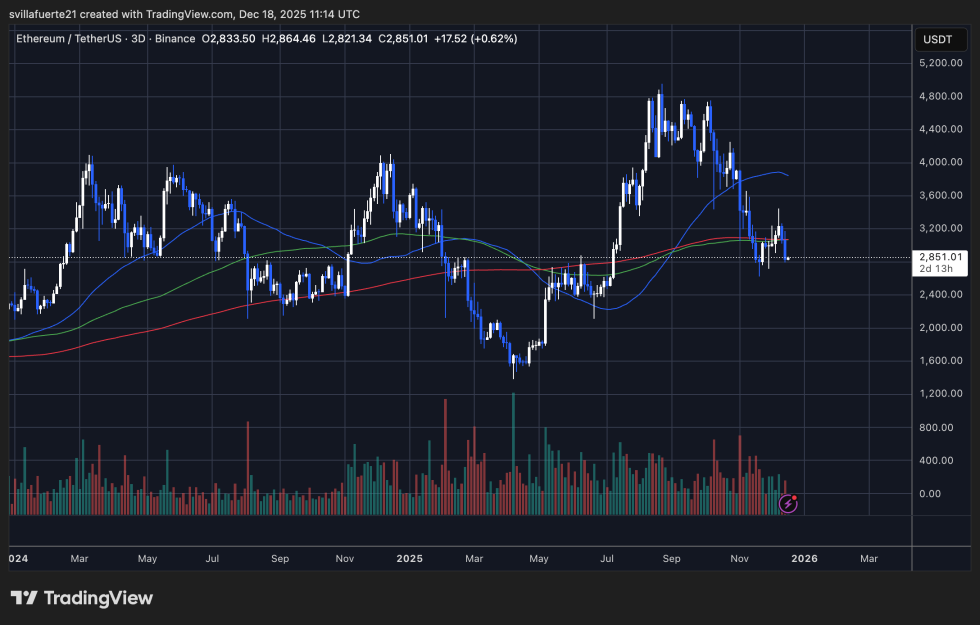
The rejection of the recent $4,000-$4,800 highs signals lower highs within the broader structure, reinforcing the idea that momentum has weakened since late 2025. The price briefly regained the 100-day moving average during the mid-year bounce, but was unable to maintain acceptance beyond that, and ETH subsequently fell below the short-term average. This suggests that the rally is still selling rather than accumulating aggressively.
The price action is consistent with the market shifting toward consolidation rather than immediate capitulation. If ETH decisively loses the $2,800-$2,750 support area, the downside risk opens towards the $2,400 area where long-term trend support converges.
Conversely, a bullish recovery would require ETH to stabilize above its 200-day moving average and regain the $3,200 level with increasing trading volume. Until then, the charts favor a cautious, range-bound outlook with downside risks still present.
Featured image from ChatGPT, chart from TradingView.com
editing process for focuses on providing thoroughly researched, accurate, and unbiased content. We adhere to strict sourcing standards, and each page is diligently reviewed by our team of top technology experts and seasoned editors. This process ensures the integrity, relevance, and value of the content for readers.


