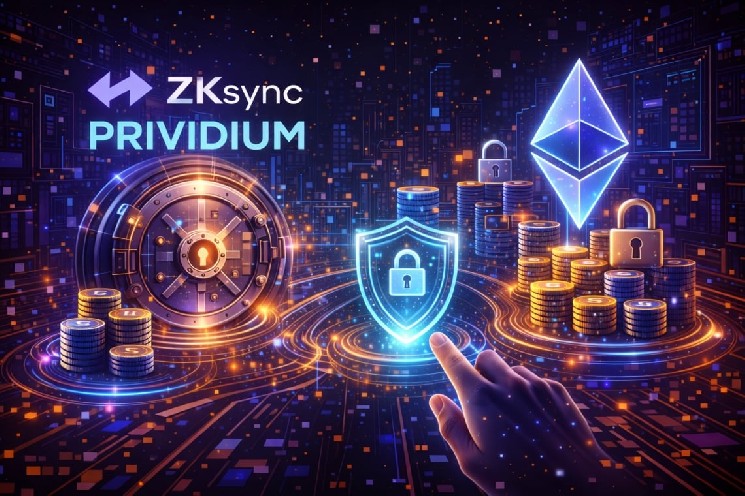
The enterprise blockchain landscape is undergoing a major transformation thanks to ZKsync and its new solution, Prividium.
This innovation extends ZKsync's capabilities beyond just public scaling and introduces a private and permissioned chain anchored in Ethereum, ensuring unprecedented privacy, security, and interoperability for enterprises.
What is prividium?
Prividium represents a private execution environment built with the ZKsync stack. It is a permissioned chain that keeps all your business data on-premises or in the cloud and maintains transactions and state from a public blockchain. However, each operation is locked into Ethereum through zero-knowledge-based validation proofs, ensuring public verifiability without exposing internal activities.
Prividium's security is based on ZK-STARK, a quantum-proof encryption technology. This makes Prividium more resilient compared to pairing-based systems, while relying on Ethereum cryptographic signatures for user authentication.
Each Prividium operates as an independent ZKsync chain with its own sequencer, prover, and state database. This security model focuses on creating and verifying evidence rather than exposing data, allowing agencies to manage high-throughput internal operations without revealing sensitive details to outside observers.
Access control and identity management
One of the important aspects of Prividium is its permission layer. The system regulates identity, access, and data visibility through an RPC proxy that enforces permissions at the contract and functional level defined in the Permissions API and admin panel. Authentication supports both enterprise SSO (Okta, Azure) and login via Ethereum wallet, integrating blockchain with existing compliance frameworks within enterprises.
Selective disclosure allows you to share specific data only when necessary, such as for audits or reporting, without exposing the entire ledger. This allows organizations to meet regulatory requirements while maintaining the confidentiality of business and customer data.
Interoperability and payments: the strength of the connection with Ethereum
Prividium is private by default, but supports interoperability with both Ethereum and other ZKsync chains. This interoperability is based on a shared payment and proof framework that enables the exchange of cryptographically guaranteed assets and messages between chains without relying on external bridges or relayers.
Prividium batches are finalized on Ethereum through STARK certificates sent to the ZKsync gateway, ensuring tamper-proof verification of each state update. This model allows financial institutions to maintain private operations while accessing liquidity, settlement, and distribution on Ethereum as needed, without locking up assets or relying on third parties.
L1 interoperability also allows the ZKsync chain to interact directly with DeFi on Ethereum, maintaining independent governance and a separate operating environment. Combined with Prividium, this architecture provides enterprises with private systems and direct access to public markets.
Airbender and Atlas: Innovations that enable Prividium
Airbender: A new standard in proof generation
Airbender, launched on June 24, 2025, is ZKsync's next-generation attestation system. Based on open source RISC-V zkVM, Airbender is 6x faster than competing solutions and requires only one GPU to generate proofs. This significantly reduces hardware requirements and costs (approximately $0.0001 per transfer) and makes proof production accessible even in managed enterprise environments.
Benchmarks show that Airbender can generate a proof for an average Ethereum block in about 17 seconds on a single H100 GPU, and 35 seconds end-to-end using recursion. These performances reduce operational complexity and enable faster and more predictable settlements between private execution and verified finality on Ethereum.
Atlas: End-to-end payment optimization
Introduced on October 7, 2025, Atlas represents a fundamental upgrade to the ZKsync stack. The goal is to not only increase throughput (over 15,000 TPS), but also to significantly reduce the latency between transaction inclusion and finality in Ethereum, bringing ZK finality to around 1 second.
Atlas deeply integrates execution, proof, and verification on Ethereum, shortening payment cycles and increasing operational predictability. This is particularly relevant for privisium, where privacy limits what can be observed from the outside and trust is based on the frequency and reliability of what is ultimately proven on Ethereum.
ZK token governance and value
ZKsync’s governance proposal aims to link the growth of cross-chain coordination and Prividium adoption to the utility and value of the ZK token. The proposed model includes two value streams: an interoperability fee for moving assets and messages between chains, and an enterprise license for institutional modules. Both streams are managed by a governance-managed purchase and allocation mechanism, with proceeds allocated to staking rewards, token burn, and ecosystem funds.
This structure incentivizes the adoption of Prividium and the use of the ZKsync network, linking the success of a private and interoperable solution to increased value of the token.
Privacy and compliance: a new era of regulation
Prividium's approach reflects a shift in the regulatory debate. The question is no longer whether privacy is possible on public blockchains, but how to ensure privacy without sacrificing accountability. Recent statements from the SEC highlight the need for systems that can verify compliance through cryptographic proofs without exposing the entire transaction history.
Prividium is fully aligned with this vision, offering default privacy, granular permissions, and selective disclosure, all of which are locked into Ethereum through ZK proofs. This allows institutions to demonstrate compliance and transactional intent without compromising business confidentiality.
Conclusion: Prividium as a facilitator of institutional adoption
ZKsync Prividium represents a decisive step towards the introduction of private, permissioned, and interoperable blockchains for enterprises. ZKsync uses Airbender and Atlas to provide a scalable and efficient platform that meets privacy and regulatory requirements. Integration with Ethereum ensures public and verifiable payments, while ZK token governance and value model ensure ecosystem sustainability and incentives.
For institutions seeking private blockchain solutions but connected to public markets, Prividium offers the ideal combination of privacy, security, and interoperability, paving the way for a new generation of enterprise applications on Ethereum.


