


Ethereum is once again struggling to regain the $3,000 level, highlighting the fragile state of the market as selling pressure continues to weigh on price action. After several failed attempts to move higher, ETH is still locked below key resistance levels. This reflects widespread uncertainty and lack of confidence among both traders and long-term investors.
Market sentiment deteriorated sharply, with apathy and fear taking over as players continued to hesitate to deploy new capital. Rather than aggressive capitulation, the current environment indicates fatigue and indecision, typical characteristics of the late cycle correction phase.
According to recent reports XWIN Research Japan on CryptoQuantEthereum is now in a late-stage bearish phase where it appears to be transitioning to a more range-bound structure. Although bearish pressure still dominates the overall trend, the nature of selling activity is changing.
Instead of rapid, panic-driven selling, the market is experiencing a slower, more methodical distribution, suggesting that many weak hands may have already exited. These changes often represent important inflection points where volatility is compressed and prices stabilize within a defined range.
report He points out that such steps typically reflect a market seeking balance. This does not guarantee an immediate recovery, but it does mean that downward momentum may weaken. For Ethereum, the next few weeks will be crucial in determining whether this range develops into a recovery base or falls to another level.
As price weakness continues, Ethereum’s on-chain structure improves.
While Ethereum continues to struggle below key resistance levels, on-chain indicators suggest that the underlying market structure may gradually improve. Data shows that ETH is leaving exchanges at the fastest rate this cycle, a move increasingly associated with self-storage, staking, and long-term holding rather than short-term trading activity.
These changes are reinforced by validator queue dynamics. For the first time in six months, the entry queue has surpassed the exit queue. Approximately 745,000 ETH is waiting to be staked and approximately 360,000 ETH is waiting to be withdrawn. The imbalance indicates a resumption of staking participation and a strengthening of the supply profile in the medium to long term.
Additional context comes from the 90-day Spot Taker CVD. This represents a shift from strong sell-dominant conditions to neutral and slightly positive pressures. This does not mean that the price will rebound immediately, but it does mean that the aggressive selling trend is starting to weaken.

That said, Ethereum ETF flows remain negative on both daily and weekly time frames, indicating that institutional demand through financial instruments continues to weigh on price action.
In addition to market trends, Ethereum’s network activity remains resilient. Deployed smart contracts reached a record 8.7 million in the fourth quarter of 2025, and on-chain real-world asset value expanded to approximately $19 billion, led by Ethereum. These trends indicate that usage-driven demand remains intact despite weak sentiment.
This data supports a scenario of continued price pressure coupled with gradual structural improvement. This assessment will be weakened if foreign exchange balances rise again or if sell-side flows regain dominance.
Price remains below key moving averages.
Ethereum continues to trade in tight consolidation near the $2,900-$3,000 area, reflecting continued indecision following a sharp correction from the $4,800 cycle high. The chart shows that ETH is struggling to regain its 50-day and 100-day moving averages, which are currently acting as dynamic resistance in the $3,200-$3,600 region. Each attempt to move higher has been met with selling pressure, reinforcing a broader bearish structure that has persisted since November.
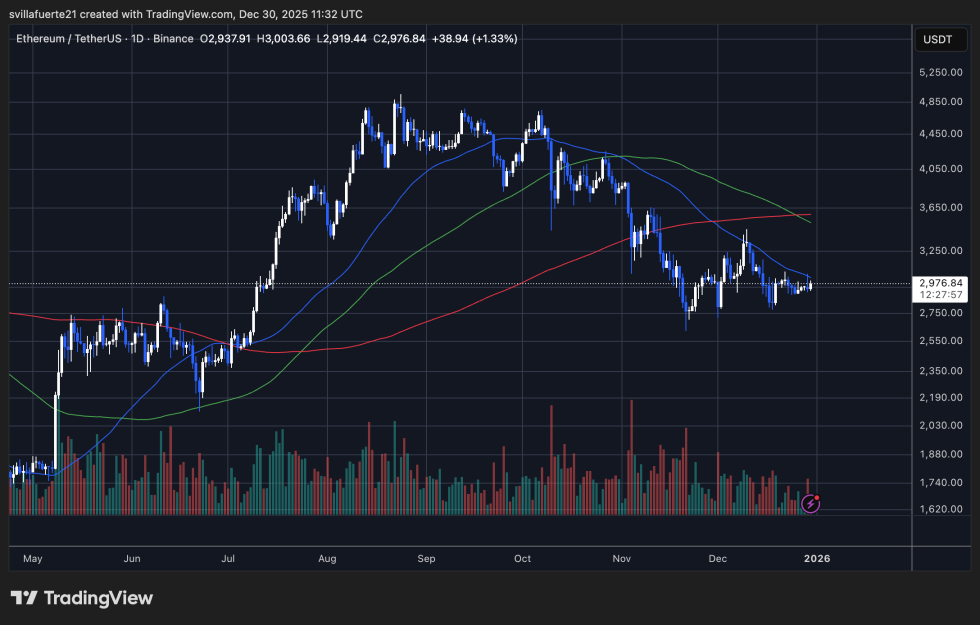
From a trend perspective, the price remains below the declining short-term moving average, while the 200-day moving average near $3,500 continues to fall. This configuration indicates that Ethereum is still trading in a correction phase rather than a confirmed recovery.
However, the downward momentum appears to be weakening. The recent series of higher lows around $2,750-$2,800 suggest that buyers are defending this range as a near-term demand zone.
Volume has also declined during recent consolidation, a sign that aggressive selling may be losing intensity. This is consistent with a broader narrative of exhaustion rather than new surrender. Nonetheless, without a decisive recovery of $3,200 and a rise above the 50-day average, the upside attempt remains vulnerable.
Featured image from ChatGPT, chart from TradingView.com
editing process for focuses on providing thoroughly researched, accurate, and unbiased content. We adhere to strict sourcing standards and each page undergoes diligent review by our team of top technology experts and seasoned editors. This process ensures the integrity, relevance, and value of the content for readers.


