


According to Vivek Raman, CEO and co-founder of Etherealize, the price of Ethereum could adjust to $15,000 in 2026 as traditional finance accelerates with tokenization, stablecoins, and custom layer 2 blockchains based on Ethereum.
In a guest post on January 5, Raman characterized 2026 as the point at which ETH transitions from a decade of trust building to an era of commercial deployment, arguing that “Ethereum will be the best place to do business from 2026 onwards” as regulatory postures, institutional precedent, and infrastructure maturity converge.
Institutions will tokenize Ethereum
Raman's core argument is that tokenization is moving from proof of concept to scaled product deployment, with Ethereum increasingly serving as the base layer authority of choice when assets are high in value and operational requirements are stringent. He describes tokenization as a business process upgrade that reduces assets, data, and payments to a shared infrastructure, leaning heavily on the idea that once institutions experience efficiencies, there is no turning back.
“Tokenization upgrades the entire business process by digitizing assets, data, and payments onto the same infrastructure,” Raman wrote. “Assets (stocks, bonds, real estate, etc.) and money will be able to move at the speed of the internet. This is a clear upgrade to the financial system that should have happened decades ago. Public global blockchains like Ethereum make this possible today.”
The post cites examples of institutional tokenization activity on Ethereum, including JPMorgan and Fidelity's money market fund initiative, BlackRock's tokenized fund BUIDL, Apollo's private credit fund ACRED (with liquidity concentrated in Ethereum and L2), and European participation such as Amundi, which is tokenizing euro-denominated money market funds. Raman also pointed to BNY Mellon's tokenized products and a tokenized bond fund plan linked to Baillie Gifford that covers Ethereum and the L2 network.
Stablecoins as a “Green Light” Moment
Raman positioned stablecoins as the best product market for on-chain finance, citing “over $10 trillion in stablecoin transfers by 2025” and asserting that “60% of all stablecoins are on Ethereum and Layer 2 networks.” Describing the passage of the GENIUS Act of 2025 as the moment when public chain stablecoin Rail effectively received official approval, he argued that regulatory developments in the US have reduced the risk of institutional deployments.
As a short-term data point, Raman highlighted SoFi's reported launch of SoFiUSD, a stablecoin issued by the bank on a “public, permissionless blockchain,” and added that the bank chose Ethereum. He suggested that this is the beginning of a wider wave in which investment banks, neobanks and fintechs are looking to issue stablecoins, either alone or through consortium structures, within a single public chain ecosystem to maximize network effects.
Layer 2 as an institutional business model
A key part of Raman's thesis hinges on the idea that institutions will not converge on a single chain, but rather on a single, interconnected network of Ethereum and its layer 2 ecosystem. He argued that L2 inherits the security and liquidity of Ethereum while offering customization based on jurisdiction and customer base, and described the L2 economy as very attractive to operators, citing “90%+ profit margins” as a reason for companies to want their own chains.
Raman listed examples including Robinhood's plans for Coinbase's Base, Ethereum L2 featuring tokenized stocks and other assets, SWIFT's use of Ethereum L2 Linea for payments, JPMorgan deploying tokenized deposits on Base, and Deutsche Bank building a publicly permissioned network as Ethereum L2.
$15,000 Ethereum price target
Raman also argued that ETH is emerging as an institutional treasury asset alongside Bitcoin, describing BTC as “digital gold” and ETH as “digital oil,” a productive store of value associated with ecosystem economic activity.
He pointed to four public “equivalent to MicroStrategy” companies accumulating ETH: BitMine Immersion (BMNR), Sharplink Gaming (SBET), The Ether Machine (ETHM), and Bit Digital (BTBT), and claimed to have purchased about 4.5% of the ETH supply over the past six months. This compares to MicroStrategy's 3.2% BTC ownership.
These dynamics support his set of “quintuple” predictions for 2026. Tokenized assets will grow to around $100 billion (estimated at around $18 billion in 2025, after growing from around $6 billion, “66% from Ethereum and its L2”), stablecoin market capitalization will expand from $308 billion to $1.5 trillion, and ETH will increase fivefold to $15,000. His framing.
At press time, ETH was trading at $3,227.
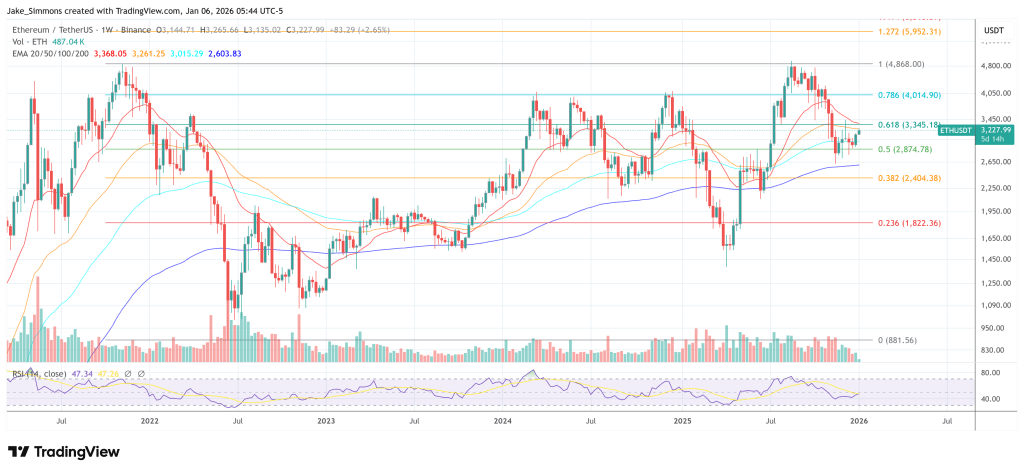
Featured image created with DALL.E, chart from TradingView.com
editing process for focuses on providing thoroughly researched, accurate, and unbiased content. We adhere to strict sourcing standards, and each page is diligently reviewed by our team of leading technology experts and seasoned editors. This process ensures the integrity, relevance, and value of the content for readers.


