


The Ethereum (ETH) ecosystem is facing a mix of structural progress and market uncertainty. Meanwhile, developers are pushing a series of scalability upgrades aimed at lowering fees and expanding capacity across the network.
Related Read: South Korea Seeks to Freeze Cryptocurrency Accounts to Prevent Market Manipulation
On the other hand, large holders are taking advantage of recent price strength to introduce short-term selling pressure to reduce their exposure. Together, these opposing forces are building Ethereum's near-term outlook as ETH trades above the $3,200 level.
The contrast is clear. While the protocol is absorbing more capital through staking and infrastructure improvements, parts of the market are testing how much supply and demand can be absorbed during a renewed rally.
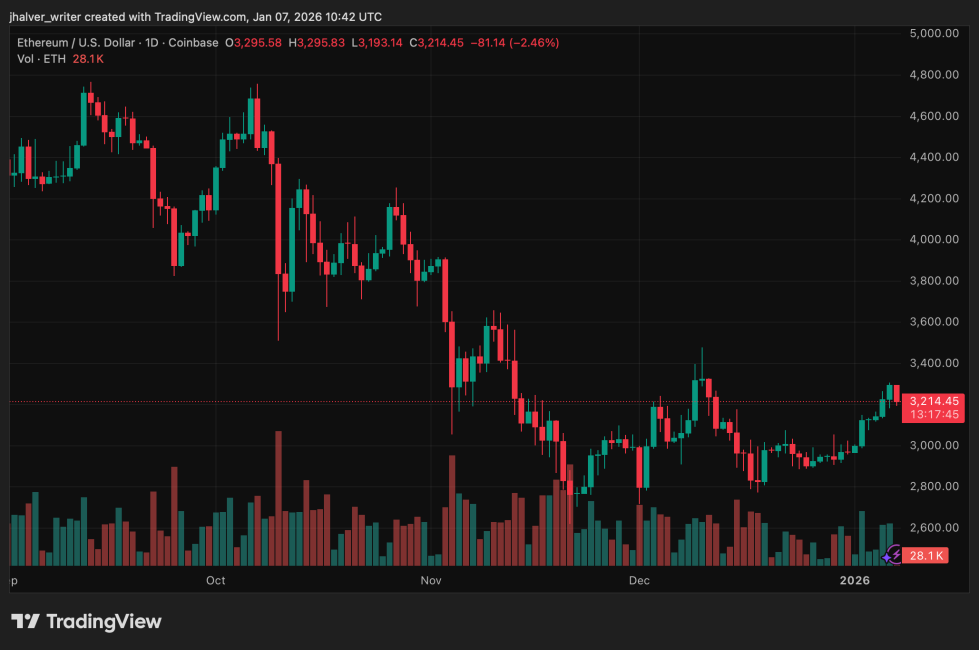
ETH's price moving sideways on the daily chart. Source: ETHUSD on Tradingview
Evolution of the scalability roadmap
Ethereum developers activated the second Blob Parameter-Only (BPO) hard fork this week, increasing the blob limit from 15 to 21 and the blob target from 10 to 14.
Blobs are temporary data containers primarily used in rollups to perform batch transactions more efficiently. Since each blob holds 128 KB, the network can now process approximately 2.6 MB of blob data per block.
This upgrade is part of a broader effort to extend Ethereum through layer 2 networks rather than pushing all activity onto the main chain. Since the first BPO fork in December, Ethereum’s transaction fees have seen reduced volatility. This reflects lower congestion as rollups move data off-chain.
Developers are already discussing further changes, including increasing the gas limit from 60 million to 80 million, and later up to 200 million, under plans for the 2026 Glamsterdam hard fork. The upgrade is expected to further increase throughput by introducing parallel transaction processing.
Increased Ethereum (ETH) staking strengthens liquidity supply.
At the same time, staking activity is reshaping Ethereum’s supply dynamics. Institutional participation has increased, as highlighted by BitMine's recent deposits, bringing total staked ETH close to 780,000 tokens worth over $2.5 billion.
Network-wide data shows that over 1.3 million ETH is waiting to be staked, while the validator exit queue has dropped to zero. This imbalance means that fewer validators choose to exit even during market volatility.
As more ETH gets locked into consensus contracts, circulating supply on exchanges is likely to continue to decline, limiting downward pressure in the medium term.
Whale sale adds to short-term pressures
Despite these fundamentals, large holders have recently become net sellers. Whale wallets holding between 100,000 and 1 million ETH sold approximately 300,000 ETH (worth approximately $970 million) over three days.
This selling coincides with ETH breaking out of a multi-week downtrend, indicating that some whales are taking advantage of the rally to take profits.
Related Read: Scudo Announcement: Tether’s Latest Cryptocurrency and Gold Gadget – Here’s the Breakdown.
Long-term holders remain largely inactive, helping stabilize the broader structure, but continued distribution by whales could blunt upward momentum. Ethereum is now at a crossroads of balancing protocol-level progress with market-driven supply pressures as traders assess whether demand can sustain higher levels.
Cover image by ChatGPT, ETHUSD chart by Tradingview
editing process for focuses on providing thoroughly researched, accurate, and unbiased content. We adhere to strict sourcing standards, and each page is diligently reviewed by our team of leading technology experts and seasoned editors. This process ensures the integrity, relevance, and value of the content for readers.


