

Ethereum price has fallen back after a steady recovery that began in mid-December. Despite falling more than 4% in the past 24 hours, ETH is still up about 5% on the week and has been trading nearly flat for the past month. This sideways movement reflects a market caught between buyers and sellers.
The recent rejection near the resistance line highlights this imbalance. Buyers continue to intervene, but they are not pressing hard enough to force a breakout. As a result, Ethereum currently stands at a key decision point where one level could determine whether the decline remains shallow or deepens further.
Symmetrical triangles and divergences indicate buyers are hesitant to resist
Ethereum has been trading inside a symmetrical triangle since early November. This pattern forms when price cuts lower highs and higher lower lows, indicating that both buyers and sellers are active, but neither side has control. This explains why ETH is struggling to trend despite multiple attempts in both directions.
This week, that tension was clearly evident. After bouncing off the lower trend line on December 18th, Ethereum rose steadily until it retested the upper trend line on January 7th. Similar to the rejection of the upper trend line on December 10th, sellers intervened and the price reversed.
Momentum confirmed hesitation. From December 10th to January 6th, Ethereum price formed lower highs, while the relative strength index (RSI) formed higher highs. RSI measures the intensity of momentum. If momentum is building but the price is not moving higher, it is a sign that buying pressure is waning. This hidden bearish divergence often appears when buyers attempt to break through resistance but fail.
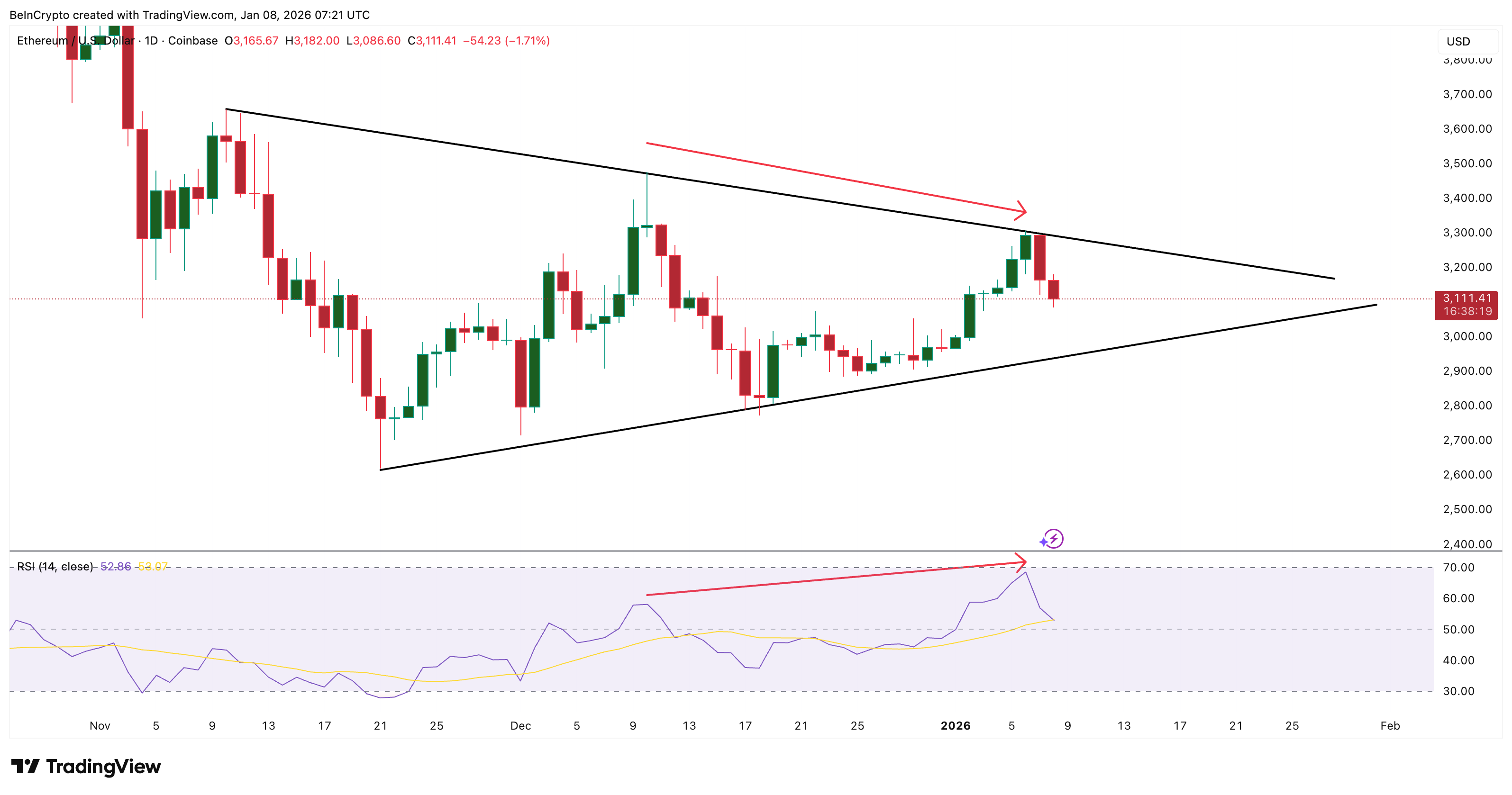
A bearish divergence is at work: TradingView
Want more token insights like this? Sign up for Editor Harsh Notariya’s Daily Crypto Newsletter here.
Simply put, buyers were interested, but they didn't follow through. The lack of commitment allowed sellers to defend the trend line again.
Short-term holders create churn as cost-based support gains traction
On-chain data can help explain why momentum has weakened. The group driving the recent volatility is very short-term holders, as shown using HODL wave data (a metric that highlights cohorts based on holding time).
As the price tested resistance on January 6th, the supply share of wallets holding ETH for one day to one week decreased from around 2.05% in late December to around 1.34%. The sell almost coincided with a rejection near the upper trend line.
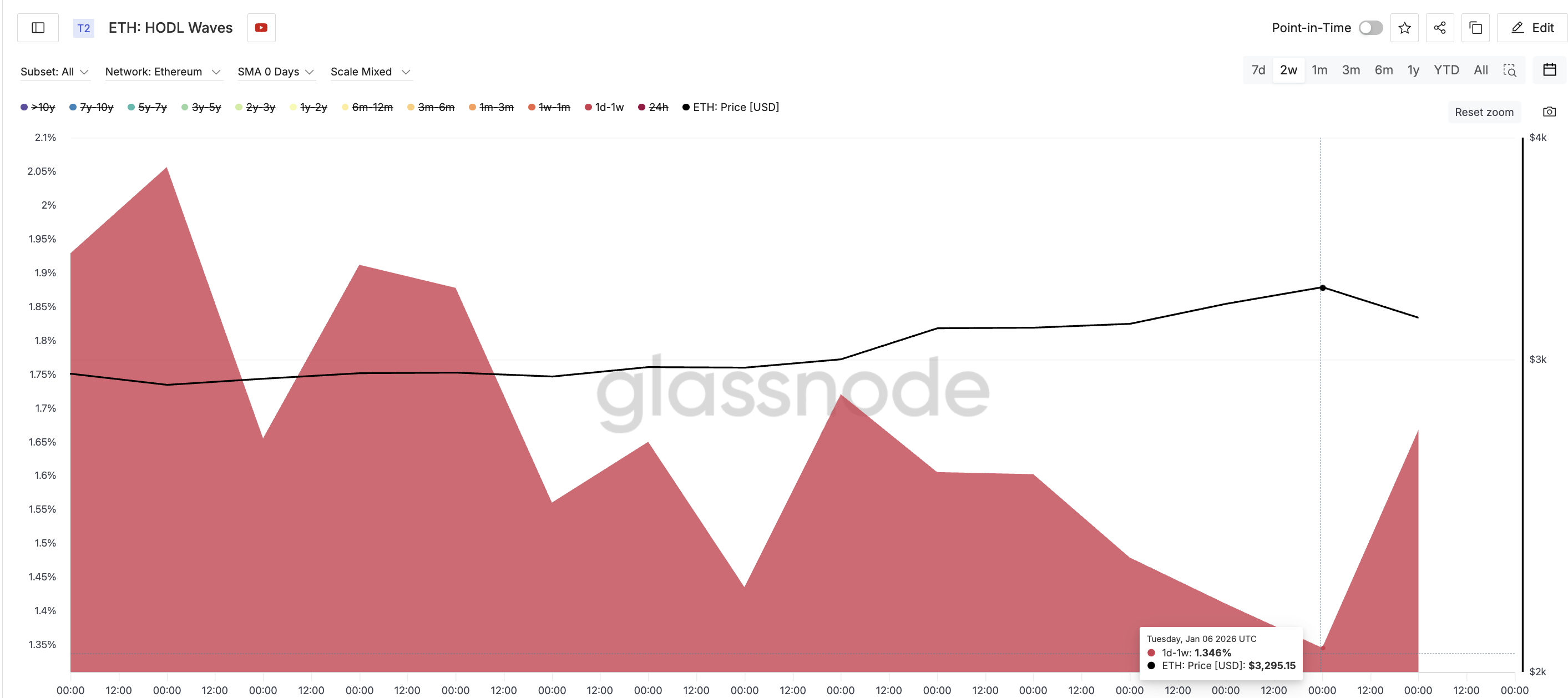
HODL Wave: Glassnode
After the pullback began, the same group started to rebuild its position and increased its share to 1.67%. This pattern of buying on the dip and locking in profits near the peak creates churn rather than direction. Pressure increases during rallies, weakening follow-through.
This behavior is important because Ethereum is traded relatively on a cost basis. A large supply cluster lies between approximately $3,146 and $3,164, equivalent to over 3.1 million ETH. This zone serves as a key decision area. If the price is above that (which it is not at the time of writing), buyers have a strong basis to work with.
If it breaks, the demand below will be diluted.

Main ETH support: Glassnode
Below that zone, the next major cluster doesn't emerge until the $2,819 to $2,835 range. In this range, approximately 3 million ETH will last traded.

Key ETH support if price continues to fall: Glassnode
This gap explains why short-term selling near resistance is dangerous. If the support breaks, the price can fall quickly before finding stronger footing.
Whales could help protect Ethereum price above $3,140
While short-term holders have increased volatility, long-term holders have quietly supported the market. Since the decline began, larger holders (whales) have started absorbing supply, helping to prevent a sharp collapse. Since January 7th, large Ethereum holders have added approximately 200,000 ETH to their balances.
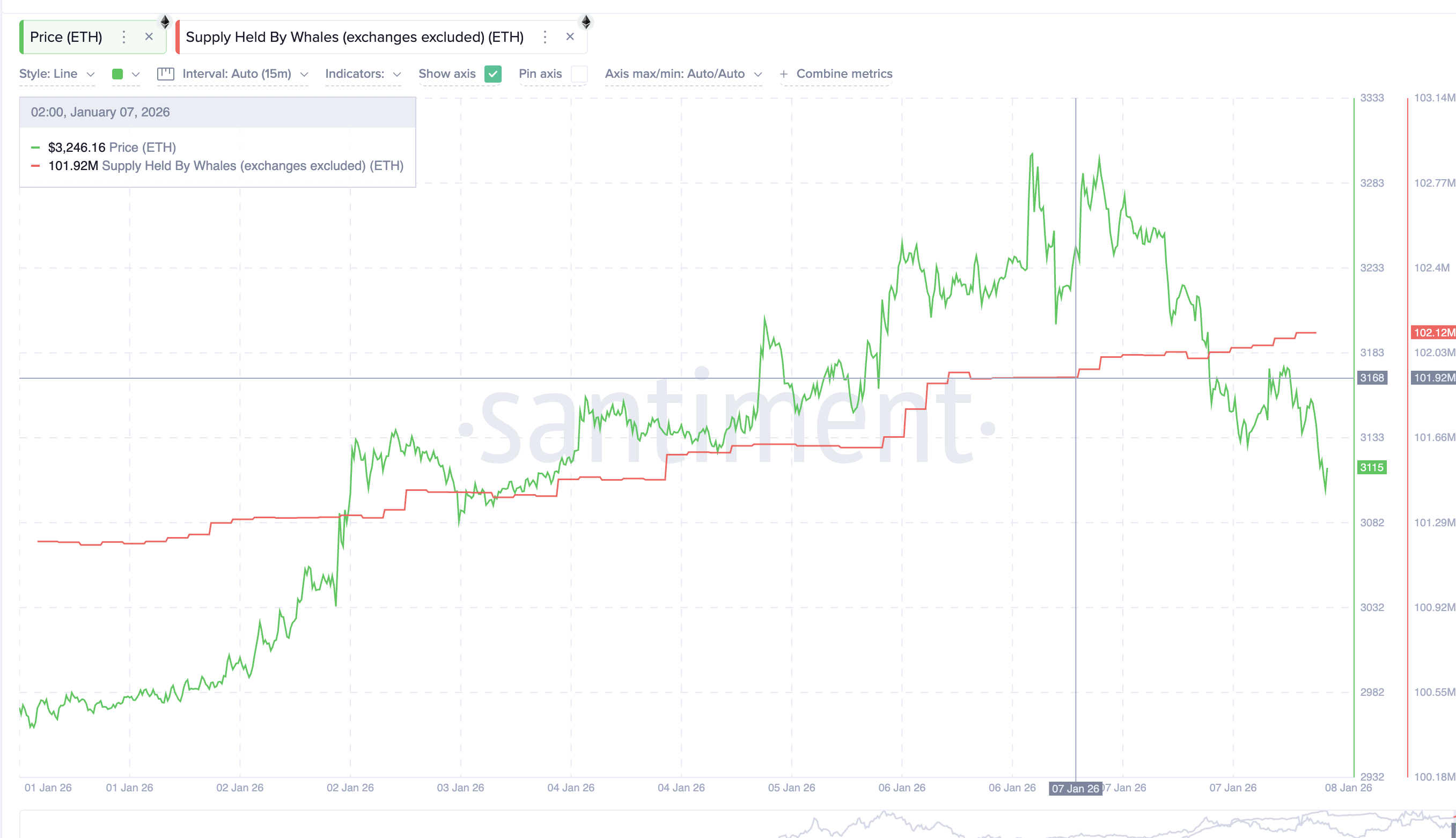
Whales may help prevent breakdowns: Santiment
At current prices, this equates to approximately $620 million worth of absorbed supply during the pullback period. It is because of this support that Ethereum has remained stable without collapsing.
Now everything is concentrated on one level. A daily close above $3,140 would place ETH above the lower end of the primary cost metric cluster, opening the way to $3,300 once again and retesting the upper bound of the triangle.
On the downside, $3,080 is the first line to look at. A sustained close below this would expose the thin demand zone below and increase the risk of further declines towards the $2,800 level.
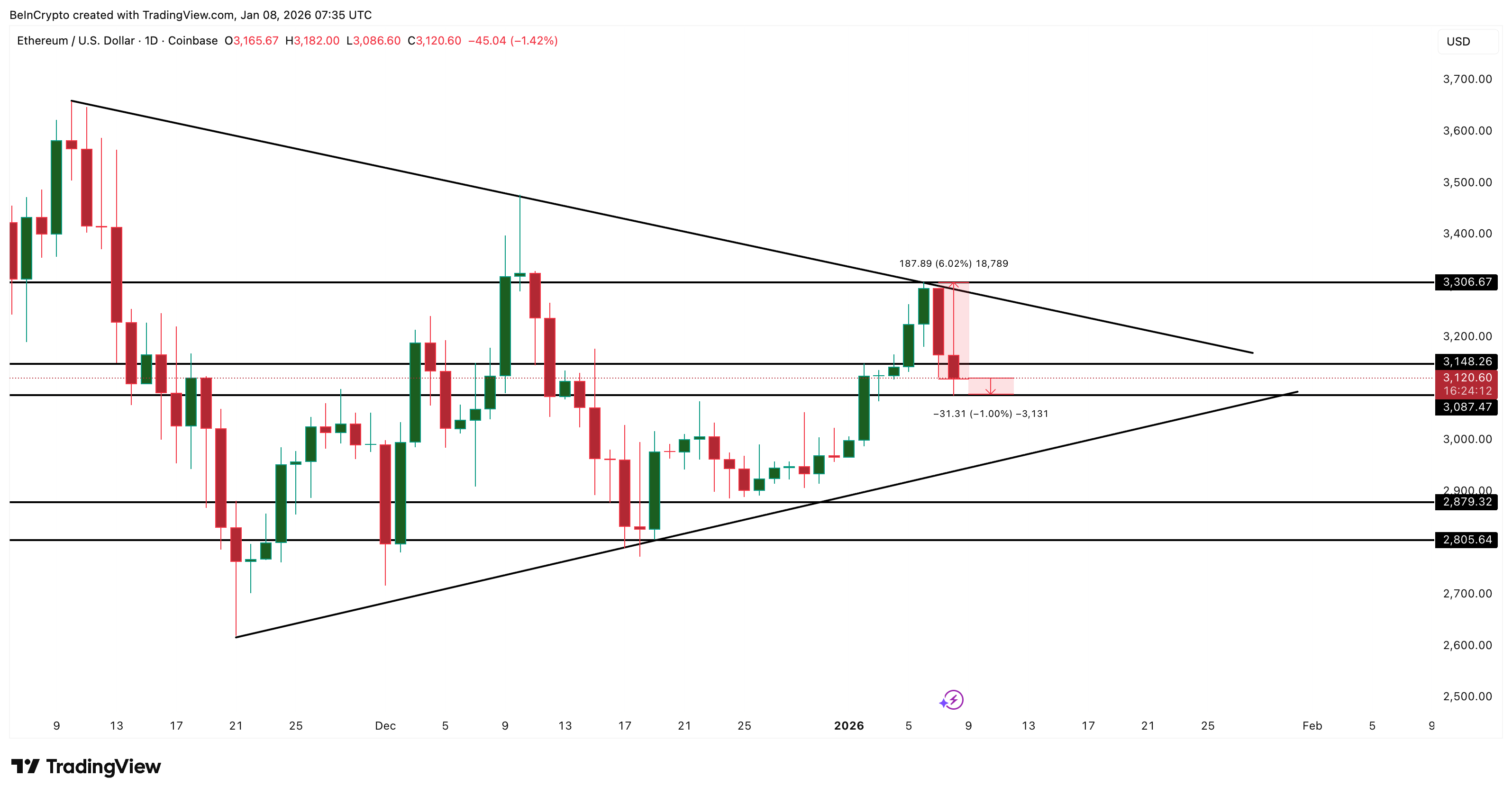
Ethereum Price Analysis: TradingView
The Ethereum price is not cheap, but it is not yet determined. Buyers exist and sellers are aggressive, but neither side is willing to apply enough pressure. Until that changes, prices will continue to hover around key levels, waiting for commitment to replace hesitation.
The post Profit Book Blocks Ethereum Price Breakout, $3,140 Is a Decision Line appeared first on BeInCrypto.


