
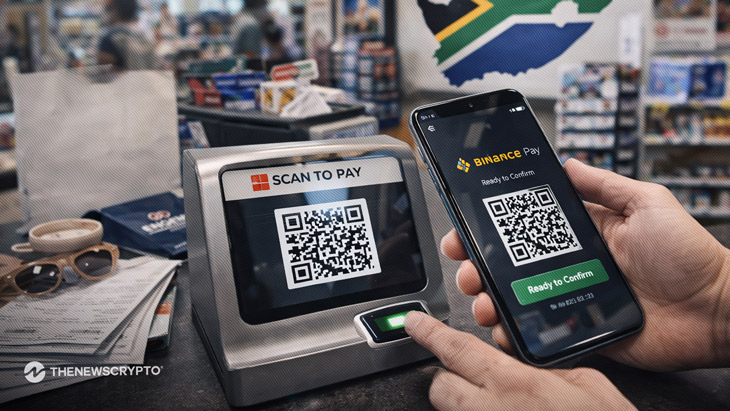
- Binance Pay can now be used for cryptocurrency payments at over 650,000 Scan To Pay merchants in South Africa.
- Users can use over 100 different cryptocurrencies with instant payments and no gas fees.
- This partnership will promote the practical application of virtual currency through collaboration with local payment platforms.
Binance Pay and Scan To Pay have partnered to facilitate the use of cryptocurrency spending in real-world scenarios in the country. As a result, it will be possible to pay with virtual currency at over 650,000 Scan To Pay member stores nationwide. This move significantly expands Binance Pay's footprint in the country, where more than 20 million businesses use its merchant network worldwide.
This partnership enables us to work with payment solutions that South Africans are already familiar with on a daily basis. Binance Pay has partnered with Scan To Pay, a system using QR code technology, to allow users to spend their digital assets hassle-free, including additional fees. This approach is consistent with broader industry trends, highlighted by recent advances in cryptocurrency adoption and increased interest in real-world cryptocurrency payments.
Cryptocurrency upgrades with daily spending
With this rollout, Binance Pay users will be able to use over 100 cryptocurrencies, including stablecoins, at a wide range of merchants. Payments are settled instantly and users can avoid gas fees altogether, making cryptocurrencies more practical for everyday purchases rather than just long-term holdings.
Purchasing fuel is one of the most visible use cases. Engen is one of South Africa's largest petrol station operators with over 1,000 outlets and is part of the Scan To Pay network. Drivers can now use Binance Pay in supported locations to fill their tank with cryptocurrencies.
Health and beauty spending also makes the list. Clicks, the nation's largest pharmacy and personal care retailer, operates more than 990 stores and 780 in-store pharmacies. Customers can pay for essentials using cryptocurrencies wherever Scan To Pay appears at checkout.
Includes payments for fashion, utilities, and communications.
This partnership is not limited to fuel or retail essentials. Rather, Scan To Pay partners include a wide range of fashion and lifestyle brands, including Birkenstock South Africa, Cotton On, Crocs South Africa, Chanel and Under Armor South Africa. This highlights the further evolution of cryptocurrency payments into everyday shopping scenarios.
Utility and service payments also form an important part of integration. Binance Pay currently supports electricity and municipal bill payments via EasyPay using the same QR-based flow. Users can manage their regular expenses without first converting their cryptocurrencies to fiat.
Telecommunications fee payment completes the service. Scan To Pay's merchant enablement allows Binance Pay users to pay Vodacom bills and process mobile top-ups using digital assets. Even shopping center parking fees are now within reach, and small and frequent transactions can now be covered with cryptocurrencies.
How to integrate Binance Pay and Scan To Pay
The process of using Binance Pay with Scan To Pay merchants has fewer steps. Using the Binance app, users open the Scan QR Code to Pay feature, scan the merchant's QR code, select and confirm their desired cryptocurrency from a selection of over 100 options. This system enables instant transactions with transparent payments.
This is reminiscent of the existing internationally recognized mode of QR payment system prevalent in different countries of the world, which was discussed by the World Bank for the implementation of national financial inclusion strategies by the Bank for International Settlements.
Why this partnership matters
Through its partnership with Money Badger, operated by the Scan To Pay system, the Binance Pay service establishes the feeling of stepping into the cryptocurrency space, as users do not need to learn another system to use the service.
This is also due to a change in the overall role of cryptocurrencies, where they are increasingly used for spending purposes rather than being used solely for speculative purposes. This is because payments have become easier and the range of merchants has expanded.


