
table of contents
Why financial privacy matters in cryptocurrencies How was Zcash born and evolved? What technology underpins Zcash's privacy features? How does Zcash's governance structure work? Where is Zcash currently used? What challenges does Zcash face? What recent developments are shaping Zcash? Can Zcash remain relevant as competition increases? What’s next for Zcash development? Conclusion Frequently Asked Questions
Zcash is a decentralized cryptocurrency that allows completely private transactions while maintaining network security through zero-knowledge cryptography. While most blockchains expose all transaction details, Zcash gives users the choice between visible payments or fully encrypted transfers through a dual-address system of transparent t-addresses and shielded z-addresses.
Started as a fork of Bitcoin in 2016, the project introduced zk-SNARK (Zero-Knowledge Succinct Non-Interactive Arguments of Knowledge) to the cryptocurrency space. This innovation positioned Zcash as the flagship project for financial privacy in cryptocurrencies, and a pioneering technology that has since influenced major blockchains, including Ethereum's scaling solution.
Why financial privacy matters in cryptocurrencies
Blockchain transparency creates a permanent public record of every transaction. While this allows for verification and auditing, it also exposes sensitive financial information not visible through traditional banking. All purchases, all payments, and all wallet balances are made public.
For individuals, this means anyone can track spending patterns, estimate assets, and identify business partners. For businesses, a transparent blockchain exposes their supplier relationships, pricing strategies, and financial status to competitors. Zcash addresses these privacy concerns while maintaining the security and decentralization that makes cryptocurrencies so valuable.
How was Zcash born and evolved?
Zcash was born out of years of academic research on zero-knowledge proofs at: Johns Hopkins University and Technion. project branched from Bitcoininherits its proof-of-work model and supply cap of 21 million coins. Bold innovation? Integrate zk-SNARKs Access protocol layers directly.
On October 28, 2016, the first block was mined, debuting peer-to-peer payments that protect privacy at the protocol level. Zcash Company later rebranded to Electric Coin Company (ECC) and spearheaded early development with a growing research community that included some of the world's leading cryptographers.
Major protocol upgrades shape network evolution
Seedling A turning point came in 2018. Prior to this upgrade, generating a shielded transaction required several minutes of computation and over 3GB of memory. How to use mobile wallet? Unrealistic.
Sapling has reduced proof generation time to just seconds and memory requirements to less than 40 MB with a new elliptic curve (BLS12-381) optimized for pairing-based encryption.
Heartwood followed in 2020, with increased scalability and miner flexibility. This upgrade enables more efficient block propagation and introduces Flyclient support. This allows light clients to synchronize with the blockchain by sampling block headers instead of downloading the entire chain.
Network upgrade 5 removes trusted setup
Network Upgrade 5 (NU5) in 2022 brings revolutionary changes that address long-standing concerns. This upgrade brings three important advances:
- Halo 2 Proof System Trusted setup rituals that previously required complex calculations by multiple parties to generate cryptographic parameters are no longer required.
- unified address It combines transparent and shielded address features into a single format, allowing wallets to automatically select the appropriate transaction type.
- Improving proof efficiency Both generation and validation speeds have been increased, reducing the computational load on users and nodes.
Governance has moved towards increasing community participation over time. What began as a primarily founder-driven project has evolved into a more decentralized ecosystem where community votes determine the allocation of funds and the direction of the protocol.
What technology powers Zcash's privacy features?
Zcash runs on a proof-of-work blockchain using the Equihash algorithm. This algorithm was explicitly chosen for its resistance to ASIC-driven mining and its emphasis on memory-intensive computations. Eventually, ASIC miners emerged, but the algorithmic design still offers more functionality. mining It is more decentralized than Bitcoin's SHA-256.
The network maintains Bitcoin's fundamental monetary properties with a four-year halving cycle. This familiar economic model provides predictable issuance that reflects Bitcoin's scarcity properties, while adding privacy features missing from Bitcoin.
Transparent and shielded addresses
Transparent addresses (t-addresses) function similarly to Bitcoin addresses. All transaction details will be published on-chain. Anyone can view the sender, recipient, and amount.
Shielded addresses (Z addresses) are a game-changer. They encrypt transaction information using zk-SNARK technology, allowing the network to verify the legitimacy of transactions while hiding the amount and participants.
This represents a radical departure from transparent blockchain design and creates a system that enhances privacy through encryption.
How zk-SNARK works
zk-SNARK is an advanced cryptographic proof that confirms the legitimacy of transactions without exposing the underlying data. A proof is generated when someone submits a shielded transaction.
This evidence proves that they have sufficient funds, that coins have not been created or destroyed, and that transactions follow all protocol rules. The network verifies the validity of the proof without learning anything about the actual details of the transaction.
Its abilities are amazing. Miners and nodes verify legitimacy without knowing who sent it, who received it, or how much money was sent.
The shielded pool acts as a cryptographic mixing service where transactions are mixed, increasing everyone's privacy as it is deployed.
The underlying mathematics of zk-SNARK includes elliptic curve cryptography and polynomial commitment. These create proofs that are “concise'' (small in size) and “non-interactive'' (no interaction required).
These properties make zk-SNARKs practical in blockchain implementations where proof size and verification speed directly impact network scalability.
Current developments are focused on post-quantum cryptographic resistance, preparing for future computational threats. Quantum computers that can break today's elliptic curve cryptography are still years or even decades away. However, through active development, Zcash remains secure even as computational power evolves.
How does Zcash's governance structure work?
Development will proceed through the Zcash Improvement Proposal (ZIP) process, an open governance framework where community members propose, discuss, and refine changes to the protocol. This transparent approach ensures thorough inspection before implementation.
Anyone can send a ZIP. Proposals should follow a standardized format that describes their motivation, technical specifications, security considerations, and implementation details.
Draft ZIPs are revised in response to community feedback and ultimately approved or rejected based on technical merit and community consensus.
Allocation of development funds
Funding comes from development funds carved out from block rewards. From November 2024, the allocation structure has changed significantly from the previous model.
Currently, 80% of block rewards go to the miners securing the network. The remaining 20% will support ongoing development and ecosystem growth through:
- Zcash Community Grants Committee (ZCG) Receive 8% to fund independent teams and projects within the Zcash ecosystem
- lockbox fund It will receive 12 percent and will be held until the community determines the appropriate distribution mechanism for future distribution.
This structure allows us to generate sustainable long-term funding without relying on external corporate sponsors or venture capital. Unlike projects that have large initial coin offerings or receive significant VC backing, Zcash's development funding comes directly from block rewards. This aligns developer incentives with the network's success over time.
The previous funding model (November 2020 to November 2024) allocated resources to Electric Coin Company, Zcash Foundation, and ZCG. The new model reflects the community's evolution towards more decentralized governance, with ZCG handling ecosystem development while a lockbox mechanism awaits community consensus on the best distribution method.
Community votes determine allocation adjustments, maintaining decentralized control over the direction of the project. The Zcash Community Advisory Panel provides input on development priorities and funding decisions, ensuring stakeholder voices influence the evolution of the protocol.
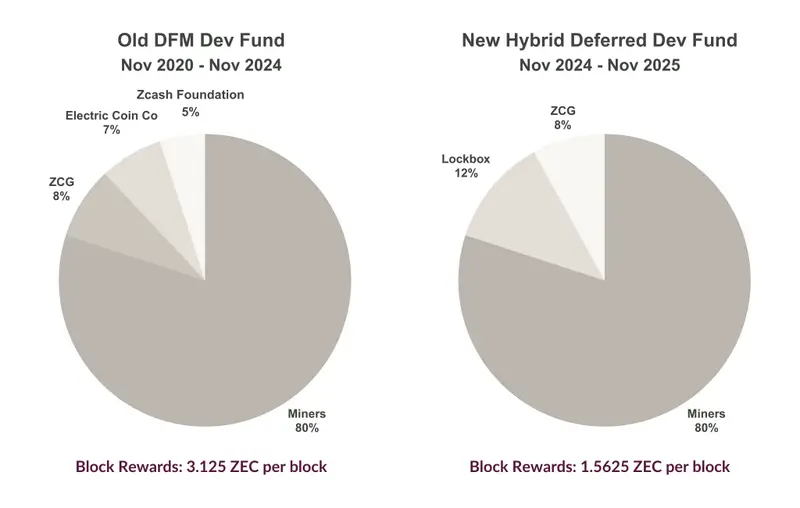
New and old development funds (z.cash)
Where is Zcash currently used?
Zcash's combination of optional privacy and technical reliability creates practical applications across multiple sectors. Shielded pools enable truly private peer-to-peer payments without exposing your transaction history to surveillance.
Real-world privacy applications
Individuals and organizations use Zcash for personal savings and store of value. They benefit from both privacy features and predictable financial policies.
While a transparent blockchain allows anyone to see your wallet balance and transaction history, Zcash's shielded addresses keep your holdings completely private while providing cryptographic proof of legitimate ownership.
Privacy-conscious services are increasingly integrating Zcash for subscription payments. Our partnership with NymVPN shows how privacy-preserving cryptocurrencies work together with privacy-preserving services. Users who pay for VPN access using Shielded ZEC maintain complete financial privacy throughout the transaction chain.
Cross-chain interoperability layers like router protocols allow shielded assets to be moved between different blockchain ecosystems. Users can move in and out of various decentralized finance protocols while maintaining the confidentiality of their transactions.
This addresses the following important gaps: DeFi Transparent trading reveals your trading strategies and holdings.
Merchants who accept cryptocurrency payments are increasingly finding Zcash to be a viable option, especially for customers who prioritize financial privacy. Transparent cryptocurrencies expose customers' purchase history. Zcash's shielded transactions protect customer privacy while providing merchants with payment certainty and low fees.
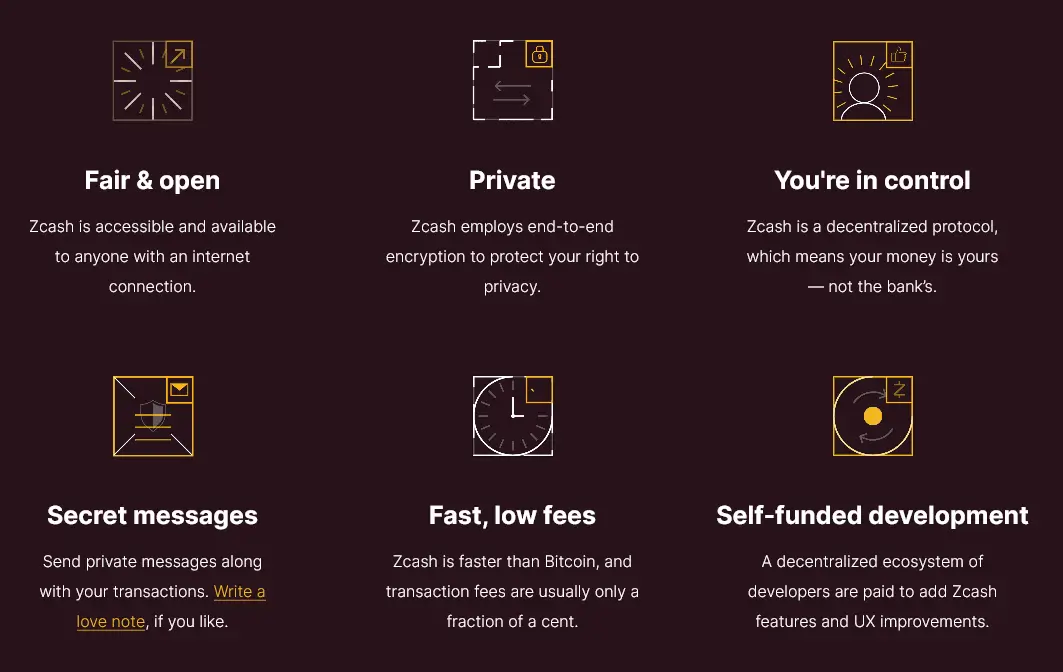
Privacy use cases and strengths of Zcash (z.cash)
Wallet development drives adoption
The Zashi wallet represents a significant step towards mainstream adoption. Rather than treating privacy as an advanced feature, transactions are shielded by default.
This design philosophy acknowledges the simple truth that most users accept default settings without understanding their technical implications. Privacy by default will be important for widespread adoption.
The wallet interface simplifies the distinction between transaction types. Appropriate options are automatically selected based on recipient capabilities and user preferences. This abstraction hides complexity that previously hindered non-technical users.
Major exchanges continue to support ZEC trading despite regulatory pressure on privacy-focused cryptocurrencies. Coinbase, Kraken, Gemini, and many other platforms offer ZEC trading pairs. Users around the world can acquire and trade Zcash through established platforms.
This accessibility could prove critical to mainstream adoption. Most cryptocurrency users prefer the convenience of centralized exchanges. Continued support shows that Zcash's optional privacy model strikes a balance that meets both user privacy needs and regulatory requirements in many jurisdictions.
What challenges does Zcash face?
Regulatory oversight is the most important ongoing challenge for Zcash and other privacy-focused cryptocurrencies. Government agencies in multiple jurisdictions have viewed optional privacy features with suspicion, linking them to money laundering and sanctions evasion.
What is the reality? Legitimate privacy use cases far exceed criminal applications.
Geographical restrictions and market segmentation
This realization has led to delisting of exchanges in certain regions. South Korea banned privacy coin trading on domestic exchanges in 2021. Japan has mandated exchanges to delist privacy-focused cryptocurrencies.
Parts of Europe are seeing exchanges proactively removing privacy coins to avoid potential regulatory complications. As a result, the global market is fragmented and the availability of Zcash varies widely by region.
The technical complexity of zk-SNARKs creates barriers for both developers and users. Generating shielded transaction proofs requires more computing power than transparent transactions, which impacts mobile wallet performance.
This complexity also makes security audits more difficult. Few experts have the specialized cryptographic knowledge required for a comprehensive review of zero-knowledge proof systems.
Competition and market awareness
Monero is a major competitive option due to its mandated privacy model. All transactions are encrypted by default. Unlike Zcash’s options approach, Monero does not have transparent transaction options.
Proponents of Monero argue that optional privacy weakens anonymity. Users who choose transparent transactions do not affect the privacy characteristics of shielded pools.
Zcash supporters counter that optional privacy provides flexibility for use cases that require transparency for regulatory compliance or audit purposes.
Public perception remains mixed. Legitimate privacy advocates compete with entities associated with illegal activities. Privacy is a fundamental right in financial transactions, but media coverage often emphasizes the use of darknet markets over legitimate applications such as protecting business confidentiality and avoiding financial surveillance.
What recent events have shaped Zcash?
Network upgrade 6.1 (NU6.1) ((November 23, 2025) We focus on improving the accuracy of shielded transactions and increasing the reliability of edge cases discovered through production use. These incremental improvements demonstrate Zcash's commitment to product-grade stability.
Improving technology infrastructure
transition to Rust-based The implementation of Node represents a major change in the technical foundation. Rust's memory safety properties prevent a wide range of security vulnerabilities that plague C and C++ implementations.
Buffer overflows, memory management issues, and other vulnerabilities that cause serious problems in cryptocurrency software do not occur in well-written Rust code.
This transition also aligns Zcash with broader trends in the cryptocurrency industry. projects such as Polka dot pattern, Solanaand others have recognized the benefits of Rust for security-critical systems. The shared ecosystem creates opportunities for code reuse and collaboration, while also attracting Rust developers to contribute to Zcash development.
With deeper integration with the zero-knowledge ecosystem, Zcash's relevance continues to expand beyond its core privacy use case. The protocol's pioneering work with zk-SNARKs established the foundational knowledge that powers it today. ethereum Rollup scaling solutions, zkSync, StarkWare, and various Layer 2 protocols.
Cross-chain privacy development
Interoperability projects increasingly recognize privacy as a missing component in cross-chain infrastructure. Bridges and wrapped assets allow the transfer of value between blockchains, but typically inherit the transparency of the destination chain. Transaction details are revealed.
Integrating Zcash’s shielded pools into cross-chain workflows provides a privacy-preserving alternative. An interoperability layer similar to a router protocol works to enable shielded cross-chain transactions that protect privacy throughout the transfer process.
These moves reflect a growing recognition that financial privacy remains essential even as blockchain technology becomes mainstream. Corporate treasuries that hold cryptocurrencies face special challenges with blockchain transparency.
Public trading records expose trading strategies and financial conditions to competitors. As more organizations become aware of these disclosure issues, privacy-protecting alternatives become increasingly attractive.
Will Zcash be able to maintain its presence as competition increases?
Zcash has established itself as the first major cryptocurrency to implement zero-knowledge proofs, giving it an enduring advantage despite newer competitors. The operational history of the network since 2016 shows a reliability that new projects cannot claim. This builds trust among users who prioritize proven infrastructure.
The project's academic foundation continues to generate research contributions that benefit the entire cryptocurrency ecosystem. Universities and research institutes researching zero-knowledge cryptography frequently refer to Zcash's implementation. They use it as a case study to generate insights that move the field forward.
Unlike many competitors that rely on venture capital funding or token distributions that centralize ownership, Zcash's development funding from block rewards creates more sustainable, long-term incentives. This model avoids the pressure of premature scaling that plagues VC-backed projects that require quick returns.
The lack of a large initial coin offering means that Zcash avoids the concentration of wealth that characterizes many cryptocurrency projects.
What’s next for Zcash development?
This roadmap focuses on expanding decentralized financial integration while maintaining core privacy features. Introducing shielded assets into lending protocols, decentralized exchanges, and other DeFi primitives requires solving complex private technical challenges. smart contract execution.
Future technology priorities
Zero-knowledge virtual machine research considers creating an execution environment in which smart contracts can operate in an encrypted state. the goal? It provides programmability to enable DeFi applications while maintaining privacy.
This represents a significant technical challenge that requires new cryptographic techniques.
As blockchain interoperability becomes increasingly important, cross-chain privacy remains a key focus area. The main areas of development are:
- Threshold signatures and multiparty calculations Decentralized validators allow a single party to manage wrapped assets without having to learn transaction details
- A bridge that protects your privacy Allows assets to be moved between chains while maintaining confidentiality throughout the transfer process.
- Mobile wallet optimization Reduce the computational requirements of shielded transactions and improve the user experience on resource-constrained devices.
Balancing privacy, performance, and decentralization presents ongoing challenges that require careful engineering tradeoffs. Enhancing privacy often requires more complex encryption, which increases computational requirements. Improving performance may require centralization that reduces resistance to censorship.
conclusion
Zcash pioneered a cryptocurrency that protects privacy through zero-knowledge proofs, creating a system that puts users in control of their financial privacy. A dual-address approach balances transparency and privacy across different regulatory environments and use cases.
Nearly a decade of technological achievements demonstrates our commitment to product-level reliability. As digital surveillance expands and financial privacy becomes increasingly scarce, Zcash's influence extends beyond its own network through its research contributions that form an entire zero-knowledge ecosystem.
Please visit officialZcash website Follow us for more details@zcash X for the latest updates.
source:
- electric coin company – Zcash development updates and technical documentation
- Zcash Foundation – Governance and community resources
- Zcash improvement suggestions – Protocol specifications
- Zcash protocol specification – Technical documentation
- CoinMarketCap – Coin Information


