

I. Consensus reached: Cryptocurrency belongs to AI agents
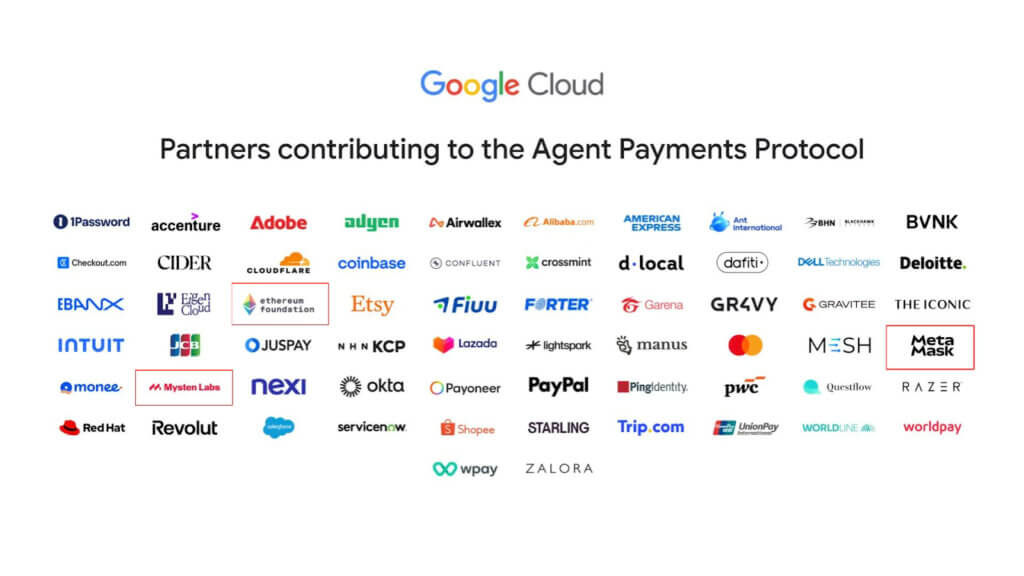
Google recently brought together leading crypto companies such as Ethereum Foundation, Mysten Labs, and MetaMask to launch the Agent Payments Protocol (AP2).
A clear consensus is emerging. Cryptocurrency will become the native economic language of AI agents.
At this critical turning point, Surge has emerged as the most promising catalyst in the Sui ecosystem.
This paradigm requires three fundamental monetary characteristics: efficiency, global reach, and programmability. Traditional fiat currencies are bound by central clearing and cross-border friction, and cannot support the millisecond transactions and cross-platform collaboration that AI agents demand.
Cryptocurrencies were built to provide things that fiat currencies cannot: decentralized payments, smart contract orchestration, instant payments, and more.
AI gives agents the ability to think. Crypto gives them the ability to trade.
These unique characteristics make cryptocurrencies an ideal monetary system for AI agents. From high-frequency algorithmic trading to cross-platform service payments powered by personal AI assistants, cryptocurrencies enable precise value quantification and secure resource transfer at scale.
Research firm Type of System predicts that the AI agent market will explode from 5.29 billion in 2023 to 216.8 billion by 2035, with an average annual growth rate of over 40%.
We stand at an unprecedented threshold.
As Sai's first AI Agent Launchpad, Surge is fundamentally rethinking the way assets are launched, incubating truly valuable AI projects while providing the critical infrastructure needed for this emerging economy.
II. Problem: Why 90% of AI projects die after launch
AI agent projects face unique challenges, including extended development cycles, steep technical barriers, and long validation periods.
The collapse of the crypto industry's startup infrastructure is exacerbating these difficulties and forcing promising projects to fail.
This malfunction results from three critical misalignments:
1. Timeline slippage: When funding timelines hinder product development
“No matter how powerful your technology is, the market won't give you time to prove it.”
This reality haunts almost every AI project.
Traditional VC funding takes 6-12 months from initial conversation to capital deployment, forcing AI teams to spend critical bandwidth on investor management rather than product development.
Once funded, teams without cash constraints often fall into the expansion trap. Core algorithm development stalls, while non-essential hires bloat headcounts and capital is wasted on premature marketing.
By the time the token is launched, the gap between the inflated initial valuation and the undelivered product can no longer be ignored. Community investors walk away. The results are predictable. Tokens crash on launch day, and technically sound projects die before the product market is suitable.
The fun part: “TGE will reveal everything.”
2. Expertise mismatch: Great engineers ≠ Effective GTM in cryptocurrencies
AI founders are typically good at algorithm development and product design, but lack critical expertise in crypto asset architecture, tokenomics, and community building. Meanwhile, community investors who crave early access to high-quality AI projects face severe information asymmetries, either missing out on truly innovative teams or becoming vaporware exit liquidity.
This capability gap prevents strong projects from securing adequate support and leaves sophisticated capital sidelined.
3. Trust Mismatch: Transparency Issues in AI Development
The inherent opacity of AI development raises fundamental trust issues. It is difficult to see the progress of algorithms. Fund allocation lacks transparency. Performance metrics can be manipulated. Traditional launch models do not provide meaningful oversight, further widening this trust gap.
The community is left with an unanswered question: “Does the team actually ship?” Are funds effectively allocated? Are hidden tokens unlocked? This eternal uncertainty prevents long-term belief formation.
The combination of these misalignments can send high-quality AI assets into destructive cycles, resulting in short runways, high trust costs, and unrealized value. Surge was built to break this pattern.
III. Solution: Redefining asset launches for long-term success
Surge is more than just a launch pad, it's a fundamental redesign of launch incentives.
Through three core mechanisms, we align project goals and community interests, creating a new paradigm for launching and growing AI assets.
1. Unlock the FDV Milestone: Make growth the only path to liquidity
The founding team behind Surge, comprised of experienced traders and quantitative analysts with deep backgrounds in both traditional financial and crypto markets, designed Surge Launch v1.0 with a novel approach. In this model, 90% of insider tokens, including those allocated to teams, advisors, and early investors, remain locked until the project reaches a certain fully diluted valuation (FDV) target. The system unlocks tokens behind 19 separate FDV milestones. This may also include technical outcomes such as model accuracy thresholds, user growth metrics, and deployment of validated use cases.
Think of this as Tesla's performance-based compensation structure for Elon Musk, minus the on-chain implementation with cryptographic guarantees.
This design completely eliminates boot-time dump scenarios. In the early stages, the unlock percentage will be minimal, so teams should prioritize product development and value creation over token sales. As the project gains serious momentum and FDV grows, the unlock rate will gradually increase. This creates a virtuous cycle in which project growth drives community interests, which in turn strengthens team incentives. We all win together.
2. Community-driven financing: Transforming retail from exit liquidity to partner
Surge completely rethinks the VC-led funding model. AI teams now have direct access to seed funding from the on-chain community. This creates benefits for both parties. Small teams can avoid months-long investor roadshows, secure startup funding quickly, and focus entirely on technical execution. Meanwhile, community members have access to high-quality projects through seed evaluation, with returns tied directly to project success.
More importantly, it fundamentally changes the role of the community. Community members become early-stage co-builders rather than later-stage exit mobility. They monitor progress, provide real-world feedback, and help improve product-market fit. The result is a true partnership between technical teams and passionate users, rather than builders competing with speculative traders.
3. Trust infrastructure: Replace promises with consensus
To solve the black box problem of AI development, Surge is implementing a comprehensive accountability system built around community governance and transparency. All funds raised flow into a community-driven treasury managed through on-chain voting. Community members monitor the deployment of funds in real-time, and all spending is transparently recorded on-chain. This means teams cannot withdraw funds arbitrarily. Instead, the community validates spending decisions and ensures resources are aligned with stated milestones and development priorities.
At the same time, all important project data (development progress, token unlock schedule, financial operations) will be recorded in real-time on Sui's blockchain. Anyone can see what their team is doing at any time through Block Explorer.
This combination of community oversight and transparent operations eliminates the trust vacuum that plagues traditional startups. All team actions leave verifiable on-chain evidence. All community funds have a clear and traceable path. The relationship changes from adversarial to cooperative.
As Surge said in an August AMA with industry founders, “A great launch helps the community sleep at night.” That's exactly the standard Surge is aiming for.
IV.Why Sui?
If AI agents define the economy of the next decade and cryptocurrencies provide the infrastructure for value transfer, Sui and Surge together will form the engine driving this transformation.
Most people don't fully understand how Move's design philosophy differs from Solidity or Rust. By eliminating the contract authentication pattern, reentrant attacks are structurally impossible. The asset-first programming model represents a true first-principles way of thinking about digital ownership.
Move brings three important benefits to Sui. That's financial-grade security, throughput of tens of thousands of transactions per second, and institutional-quality infrastructure. These are exactly what AI agents need to perform high-frequency transactions, execute complex contracts, and collaborate cross-platform.
Institutional verification speaks for itself. Circle's IPO filing revealed that Sui is the country's largest cryptocurrency holder. Grayscale has launched dedicated investment products for Walrus and DeepBook. This is not just hype, but sophisticated capital that sees Sui as a bridge between traditional finance and cryptocurrencies, building the foundation needed to deploy exactly the AI agents.
Surge addresses a critical gap in the Sui ecosystem: AI asset issuance and incubation. But it doesn't just provide the infrastructure, it acts as a quality filter. The FDV Milestone System recognizes teams that are truly committed to building for the long term. Through community co-creation, targeted resources are allocated to appropriate projects. Transparent trust mechanisms reduce coordination costs across the ecosystem.
This is the most fascinating part. AI assets cultivated through Surge will be seamlessly integrated into Sui's growing application layer. These assets can participate in DeFi protocols to fund the computing purchases of AI agents. You can bet on AI projects and get a revenue share. These serve as payment tokens that enable autonomous transactions between different agents.
This creates a complete value loop. Assets enable use cases, use cases generate value, and value returns to assets. This flywheel effect accelerates the adoption of AI agents across Sui.
V. Conclusion
The possibilities are endless. History is being written in real time.
At a tipping point in the economics of AI agents, Surge has evolved beyond mere launch infrastructure. This is becoming the foundational layer that determines how high-quality AI assets are brought to market, sustainably grow, and provide lasting value.
The convergence of AI and cryptocurrencies is not speculation, but an ongoing economic restructuring. Surge enables the entire lifecycle of launching, growing, and realizing value for AI assets.
For AI builders: This is a path to escape the funding arena and focus on technical excellence.
For community investors: This is your entry point to next generation AI + Web3 value creation.
A new economic layer powered by AI agents is emerging. The high-quality assets selected and cultivated through Surge will become the foundational currency of this era.
Build with Sui. Start with surge. The convergence is here.
The future begins now.
About surge:
- Website:surgeai.io
- X: x.com/SurgeOnSui
- GitBook:urgeai.gitbook.io/docs/
- Email: (email protected)


