
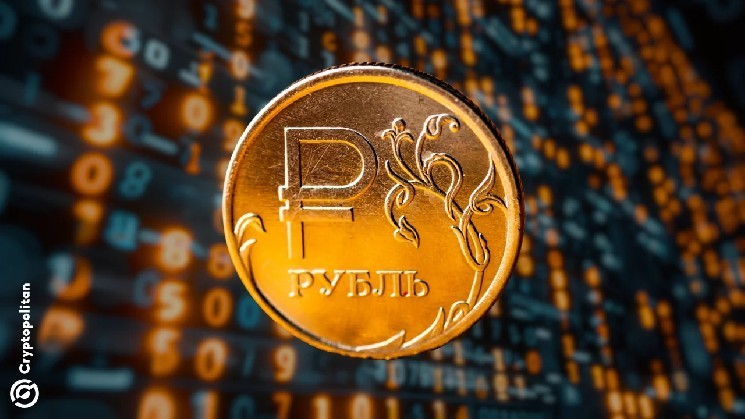
Cryptocurrency mining has contributed to the recent appreciation of the ruble, the head of the Bank of Russia admitted.
The statement confirms claims by Kremlin officials who recently pointed out that this activity is affecting the country's currency market.
CBR Governor cites mining as a factor behind ruble appreciation
Central Bank of Russia (CBR) Chairman Elvira Nabiullina acknowledged that Bitcoin mining is one of the reasons for the current appreciation of the Russian ruble.
The governor made this recognition during a press conference where he was asked to comment on the importance of the revenue generated by the industry.
In response to a question from business news portal RBC, Nabiullina stressed that it remains difficult to measure its influence as a large part of the sector remains in the gray economy at the moment.
Citing the Interfax news agency, the CBR chief said that no cryptocurrency mining, which will be regulated in 2024, took place in Russia this year. Therefore, the increase in the ruble price is not only due to this sharp increase in activity. At the same time, she also said:
“Nonetheless, mining is certainly one of the additional factors contributing to the ruble's strong exchange rate.”
At the time of writing on Saturday, the dollar was trading at just over 80 Russian rubles, down from over 110 Russian rubles in January, after hitting a year-to-date low of around 76 Russian rubles in early December.
Elvira Nabiullina's statement follows comments on this issue by senior representatives of President Vladimir Putin's government.
At an international investment conference hosted by one of Russia's largest banks, Kremlin officials noted that capital flows related to cryptocurrency mining are currently being underestimated.
At the “Russia Calling!” lecture forum, Deputy Chief of Staff of the Presidential Office Maxim Oreshkin claimed that this is giving rise to false predictions about the exchange rate of the Russian ruble.
He went on to point out that mining has become Russia's “hidden export” and has an impact on the foreign exchange market, suggesting that mining should be factored into the country's balance of payments.
“There is a new export item, an undervalued item, and that is crypto mining,” Oreshkin elaborated, adding that he had not seen such an estimate from the central bank, and concluded:
“This supply of money will have an impact on the currency market, as imports can now also be paid for in cryptocurrencies.”
The Governor of the Bank of Russia insists that it is not just about mining.
Elvira Nabiullina believes there are other reasons for the ruble's strength. Examples include efforts to legalize imports from Russia and an overall decline in volumes under sanctions imposed over the Ukraine war.
He explained that the share of imported goods and services in Russia's gross domestic product (GDP) has shrunk significantly compared to the 2020-2021 level, which also has an impact on the ruble exchange rate.
The strengthening of the country's fiat currency may be partly due to an increase in the Russian government's “recycling fee” on some imported goods, such as cars, which was raised in October 2024 and re-indexed in January this year.
“Companies imported cars ahead of the recycling fee hike, and car imports this year certainly fell significantly compared to last year,” the central bank governor noted.
Nabiullina acknowledged that the CBR had not yet accumulated enough data to properly assess the effectiveness of import legalization, and said that counter-smuggling measures could also play a role if they prove effective.
The Moscow government is currently finalizing plans to further boost Russia's economy from the shadows, by order of President Putin himself. As reported by Cryptopolitan, proper legalization of mining and cryptocurrency circulation is one of the key challenges for 2026 listed in the document.


