


Bitcoin's price action over the past week is a perfect illustration of Bitcoin's performance this year. The leading cryptocurrency has experienced incredible levels of volatility throughout this week, fluctuating between $90,000 and $86,000 over the past few days.
The latest market valuations indicate that the future for Bitcoin price could be bleaker than just sideways volatility. According to a notable cycle, the BTC price cycle has turned and is entering a bear market.
Bitcoin’s cyclical behavior depends on the demand cycle: CryptoQuant
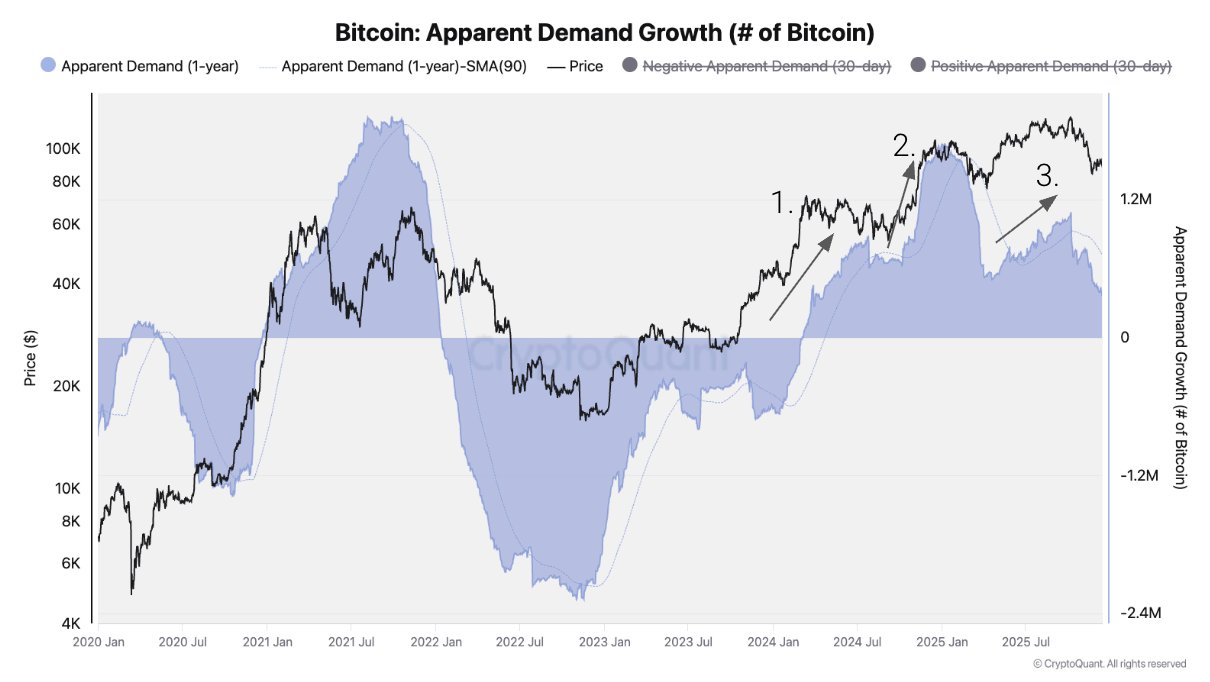
Blockchain analytics firm CryptoQuant links the steady decline in Bitcoin prices to the fading demand boom in its latest market report. Data from on-chain platforms shows that BTC demand growth will slow into 2025, suggesting the beginning of a bear market.
CryptoQuant highlighted that since the bull cycle began in 2023, Bitcoin has had three major waves of spot demand, driven by the US spot ETF launch, the US presidential election results, and the Bitcoin Treasury bubble. However, demand growth has slowed since early October 2025.
Not surprisingly, this reversal in demand growth coincides with the October 10th market catastrophe, one of the largest liquidation events in crypto history. Since then, Bitcoin price has struggled to recover convincingly, falling to $82,000 in late November.
Source: CryptoQuant
CryptoQuant further hypothesized that as most of this cycle's increased demand has already been realized, a key pillar of price support has been removed. For example, a US-based Bitcoin exchange-traded fund (ETF) will become a net seller in the fourth quarter of 2025 due to weak demand from institutional and large-scale investors.
According to CryptoQuant data, US spot ETF holdings fell by 24,000 BTC in Q4 2025, which is far from the steady accumulation seen in Q4 2024. “Similarly, addresses holding 100-1,000 BTC, representing ETFs and treasury companies, have increased below trend, reflecting the deterioration in demand seen at the end of 2021 and the bear market in 2022,” the blockchain company added.
In addition to weaker spot demand, the Bitcoin derivatives market has also seen reduced activity and reduced risk appetite. CryptoQuant revealed that BTC funding rates have fallen to their lowest levels since December 2023, an on-chain signal that suggests traders are less willing to maintain long-term exposure. This trend is often associated with bear markets.
Ultimately, the blockchain company concluded that Bitcoin's four-year cycle is not a halving event, but instead depends on phases of demand, or expansions and contractions in demand growth. Basically, bear markets tend to occur after BTC demand growth peaks and collapses.
What’s next for BTC price?
CryptoQuant revealed in a report that Bitcoin's price structure is deteriorating due to weak demand. The flagship cryptocurrency is currently trading below its 365-day moving average, a key long-term support level that has historically separated bullish from bearish phases.
According to CryptoQuant, the downside water mark suggests that the Bitcoin bear market may not be as deep as feared. Similar to previous bear seasons, the realized price (currently around $56,000) is being recognized as a potential bottom.
This suggests a potential 55% correction from the most recent all-time high, which is Bitcoin's smallest ever drawdown (during a bear market). Meanwhile, the market leader's intermediate support level is around $70,000.
As of this writing, BTC price is around $88,170, reflecting a 3% increase over the past 24 hours.
The price of BTC on the daily timeframe | Source: BTCUSDT chart on TradingView
Featured image from iStock, chart from TradingView
editing process for is focused on providing thoroughly researched, accurate, and unbiased content. We adhere to strict sourcing standards, and each page is carefully reviewed by our team of top technology experts and experienced editors. This process ensures the integrity, relevance, and value of your content to your readers.


