

Charles Schwab's decision to add Solana futures marks a notable change in the way traditional investors access the SOL market. The brokerage firm, which manages over $10 trillion in client assets, now allows institutional investors and individual participants to trade contracts linked to Solana without holding any tokens. This step places Solana within a regulated intermediary infrastructure and expands its reach beyond native crypto platforms and exchanges.
Importantly, this move mirrors previous milestones seen with Bitcoin and Ethereum. Bitcoin futures entered mainstream securities trading platforms in 2017, followed by Ethereum in 2021. As a result, Solana is now entering a parity phase where price discovery increasingly reflects both spot trading and derivatives positioning. In addition to increased access, futures trading also enables hedging and structured exposure within risk-managed portfolios.
Institutional access changes SOL’s market profile
The availability of SOL futures provides increased visibility within the traditional trading environment. Additionally, the way capital and assets interact will change. Exposure is no longer solely dependent on direct token purchases. Rather, allocation decisions, leverage, and hedging strategies may play a larger role in short-term price trends.
Additionally, this structure matches Solana Use assets that are already part of your organization's workflows. As a result, SOL price movements may increasingly respond to broader portfolio adjustments rather than individual cryptocurrency sentiment. However, increased access doesn't necessarily mean things will pick up right away, especially if market conditions are down.
Analysts warn of continued technical pressures
Despite the structural milestones; Solana Price trends remain under pressure. SOL trading price $127.82reflecting a daily decline of 0.57% and weekly decline of 6.73%. The asset has a market capitalization of nearly $71.8 billion and is highly liquid across major exchanges.
Trader Koala pointed out that SOL closed the week even lower than the weekly EMA200. Therefore, the overall trend remains bearish. He highlighted the $89 to $101 zone as the next major area of demand. According to his analysis, a deeper risk-off move could push the price towards the long-term support range between $30 and $50.
Short-term structure remains weak
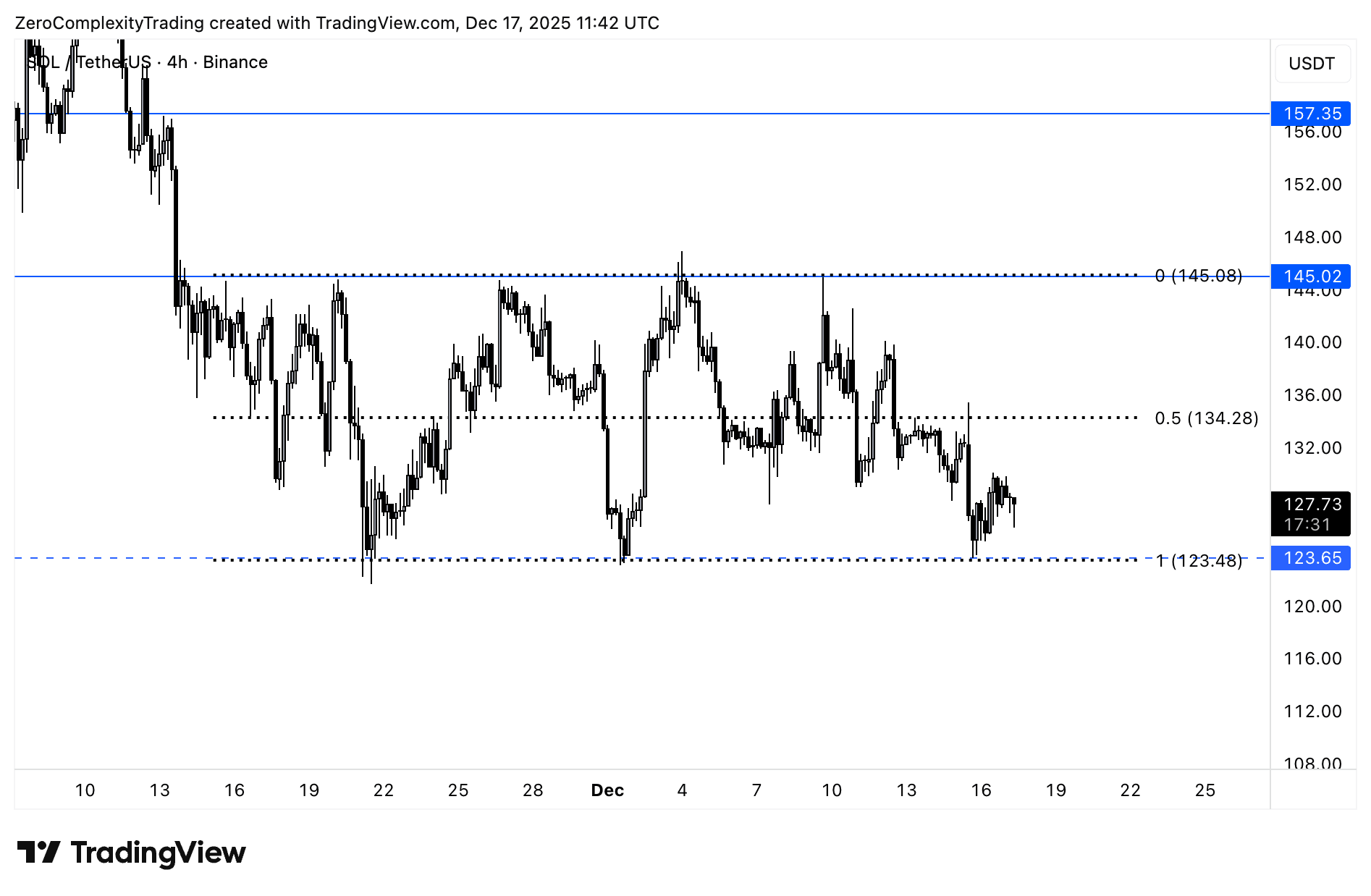
Additionally, Koroush AK focused on short-term price trends. He observed a gradual rebound around $123 to $125, which acts as short-term demand. However, follow-through remains limited. SOL continues to form highs below the midrange level of $134.
sauce: ×
Koroush AK warned that a push back towards $125 on rising volume could lead to acceptance below range support. That scenario would therefore increase the risk of a broader collapse. A complete loss of $123 could expose $118 and $110. On the upside, the bulls need to recover $134 to stabilize the structure, but $145 remains a key resistance level.


