
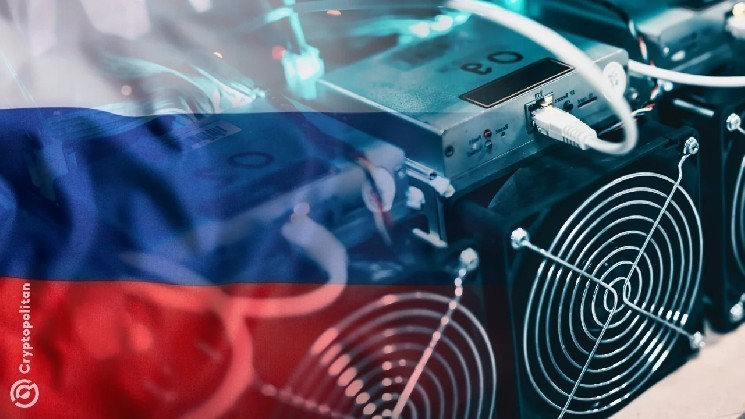
The number of mining farms in Russia has increased significantly over the past year since Moscow legalized cryptocurrency activity in 2024.
Industry insiders say this upward trend is mainly due to increased investment in the sector following recognition as a legitimate business. Some argue that illegal mining is also contributing.
Russia uses AI technology to count crypto farms
The number of farms minting digital currencies such as Bitcoin has increased by 44% this year, despite a ban currently in place in more than a dozen regions of Russia affected by energy shortages caused by the mining boom.
The total number stands at 196,900, according to a report produced by a new system designed to identify such facilities even if they are not officially reported to the government.
The EnergyTool platform was developed by Russian telecommunications company MTS. Discover cryptocurrency mining facilities by monitoring power consumption.
This is achieved by analyzing information collected from automated metering systems in real time and using AI to record anomalies in power usage to detect unauthorized connections to the power grid, meter tampering, and abnormal loads.
The solution relies on artificial intelligence and machine learning algorithms and has been in operation for several years. MTS announced in January that it had been granted the patent.
According to the tool's latest data cited by RBC Business News and Kommersant, crypto farms will proliferate across Russia by 2025. For comparison, at the end of 2024, that number was 136,600, an increase of only 7% from the previous year.
Irkutsk retains title of Russia's mining capital despite restrictions
According to MTS analysis, three Russian regions lead in newly discovered crypto farms: the Siberian regions of Irkutsk and Novosibirsk, and the Republic of Southern Bashkortostan (Bashkiria).
Irkutsk, also known as the mining capital of Russia, has attracted cryptocurrency miners due to its relatively low electricity costs.
Both legal and illegal coin minting operations were concentrated there, leading to a permanent mining ban in the southern part of the region. More than 10 Russian regions have already banned the activity until 2031.
Meanwhile, the Republic of Khakassia has replaced Irkutsk as the most profitable location for mining, followed by the Tyumen and Murmansk regions.
The least recently discovered mining facilities were registered in the regions forming the Volgograd, Ivanovo, Sverdlovsk regions, the Chuvash Republic (Chuvashia), the Yamalo-Nenets Autonomous Okrug, the Altai region, and the Central Black Earth Region.
New investments to boost Russian mining growth
MTS' findings suggest that the legalization of cryptocurrency mining, which has become Russia's first regulated cryptocurrency industry, has significantly contributed to the rapid expansion of the business through the influx of investment funds.
Sergei Bezderov, chairman of the Russian Mining Association, agrees that this surge is a direct result of the sector being recognized as an investment vehicle. He elaborated:
“Since the state regulated mining in August 2024, institutional investors have finally shifted into the industry, resulting in numbers like this.”
Bezderov believes that the increase in mining operations is partly due to a move away from the shadow economy, but he also points out that it is difficult to count the number of mining operations that remain under the radar.
To mine legally in Russia, companies and individual entrepreneurs only need to register with the Federal Tax Service (FNS) and pay taxes.
However, the actual registration rate remains quite low, at around 30%, according to recent estimates cited by Russian officials.
Proposed solutions to the problem include plans to criminalize illegal mining and proposals to grant amnesty to companies operating in “gray zones.”
Russian authorities, with the help of telecommunications companies, are using increasingly sophisticated means to crack down on criminal activity in this sector, such as tracking electricity consumption via smart meters and internet traffic.
At the same time, as reported by Cryptopolitan, the growing importance of the cryptocurrency mining industry to the sanctioned Russian economy has been acknowledged by both the Bank of Russia and the Kremlin.
For now, it remains unclear whether the legal or illicit sectors of the market are contributing more to its growing importance.
Anton Gontarev, commercial director at industry giant Intelion Data Systems, agreed with Bezderov and said the upward trend is due to a serious influx of capital into the currently regulated sector.
Meanwhile, a representative of the Russian energy company EN+ said that the increase in the number of cryptocurrency farms is mainly linked to the increase in illegal mining.


