
The European Central Bank (ECB) may soon have to consider stablecoins not only as a regulatory concern, but also as a potential source of macroeconomic shocks, according to Dutch central bank president Olaf Slijpen.
In an interview with the Financial Times, Slypen warned that rapidly growing dollar-pegged stablecoins could become systemically relevant to Europe's financial ecosystem. He said that if the token becomes unstable, it could affect financial stability, the overall economy, and even inflation.
“If a stablecoin is not very stable, you could end up in a situation where you have to sell the underlying assets quickly,” he said, stressing that rapid liquidations could amplify overall market stress.
Slijpen said the ECB could be forced to “reconsider monetary policy” if the shock is strong enough. However, he stressed that it is unclear whether such a scenario would require a rate hike or cut.
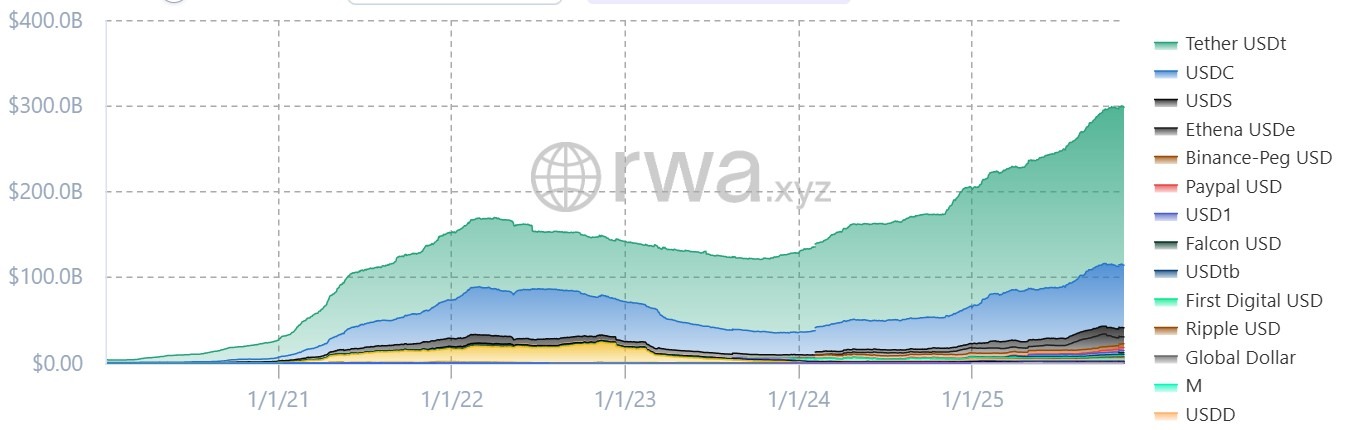
Stablecoin Market Growth from 2020 to 2025. Source: RWA.xyz
Stablecoin market capitalization could reach $2 trillion in 2028
Slypen’s comments come during a year of explosive growth for the stablecoin sector. According to data from CoinGecko, stablecoin market capitalization has increased by nearly 50% this year. As of this writing, the total valuation of stablecoins is $310 billion.
Tether’s USDt (USDT), the top USD-pegged stablecoin on the market, has grown from a market cap of $127 billion in November 2024 to a market cap of $183 billion in the past year, marking a 44% increase.
USDC (USDC), the second largest stablecoin asset, grew almost 100% over the same period, from $37 billion to $74 billion.
In April, the US Treasury reported that evolving market dynamics could accelerate stablecoin growth. The Treasury Department predicted that stablecoins could reach a market capitalization of $2 trillion by 2028.
Slypen said that as dollar-pegged stablecoins continue to grow, the sector could reach a scale where its fluctuations directly impact Europe's economic outlook.
Related: EU considers SEC-like oversight of stock and crypto exchanges to strengthen startup environment
Concerns about dollar-backed stablecoins in Europe
In April, ECB board member Piero Cipollone wrote an article highlighting concerns about the growth of dollar-backed stablecoins.
He argued that the creation of a central bank digital currency (CBDC) could help maintain the eurozone's monetary sovereignty. He said a digital euro could limit the potential for foreign currency stablecoins to become a more popular medium of exchange in Europe.
Italy's Economy and Finance Minister Giancarlo Giorgetti also expressed concerns about the US dollar stablecoin. Giorgetti said in April that stablecoins pose a greater threat to Europe's financial stability than trade tariffs.
While concerns about stablecoins are clear, Sleipen's comments highlight a more pressing concern: that stablecoin issuers can become vectors for financial instability. A major release of reserves by large issuers could have implications for liquidity conditions, asset prices and inflation.
Nobel Prize-winning economist Jean Tirole warned in September that governments could face multibillion-dollar bailout pressure if major stablecoins fail.
magazine: 2026 is the year of practical privacy in crypto: Canton, Zcash and more


