


Ethereum co-founder Vitalik Buterin made the call in 2026, switching his
“Welcome to 2026! Milady is back.” Buterin wrote before explaining Ethereum's progress toward 2025: higher gas limits, higher blob counts, better node software quality, and zkEVM hitting key performance milestones. He also claimed that “with zkEVM and PeerDAS Ethereum has made its biggest strides towards becoming a fundamentally new and more powerful type of blockchain.”
Ethereum should power the world computer
But the post's center of gravity wasn't the victory lap. It was a warning that the network was still falling short of its own stated goals and that it wasn't important to chase every story that was currently gaining traction.
Buterin drew a clear line between Ethereum’s long-term mission and the trend-driven incentives that often dominate cryptocurrency cycles. “Ethereum needs to do more to achieve its stated goals,” he wrote. “It’s not a quest to ‘win the next meta’, whether it’s a tokenized dollar or a political memecoin, or arbitrarily persuading people to fill block space to recreate ETH ultrasound, but a mission: to build a world computer that serves as a central infrastructure piece of a freer and more open internet.”
In it, he explained what a “world computer” should actually mean. That is, they are decentralized applications that cannot be quietly changed or terminated and that can continue to be used even when the companies and infrastructure that most users take for granted fail.
“We are building decentralized applications – applications that run without fraud, censorship, or third-party interference,” he wrote. “Applications that pass the WalkAway test: will continue to run even if the original developer disappears. Users of the application will not notice if Cloudflare goes down or if Cloudflare as a whole is hacked by North Korea.”
Buterin extended the same expectations beyond finance, explicitly identifying identity, governance and “other civilizational infrastructures that people want to build,” emphasizing privacy as a core asset rather than a nice-to-have.
A notable thread in the post is Buterin's refusal to treat utility at scale and decentralization as trade-offs that Ethereum could punt on. “To achieve this, it must be (i) available at scale and (ii) truly decentralized,” he wrote, arguing that these requirements apply to both the base and application layers, “including the software used to run and communicate with the blockchain.”
This framing implicitly puts pressure on multiple constituencies simultaneously: core protocol operations, client diversity and quality, an infrastructure that is not centralized around a few providers, and a Dapp architecture that can withstand developer abandonment while meeting user expectations.
Buterin ended on a note of determination rather than specifics, saying that Ethereum has “powerful tools” but needs to be applied more aggressively. “All of these areas need to be improved. They are already improving, but they need to be improved further,” he wrote. “Fortunately, we have powerful tools, but we have to apply them and we will.”
At press time, ETH was trading at $3,030.
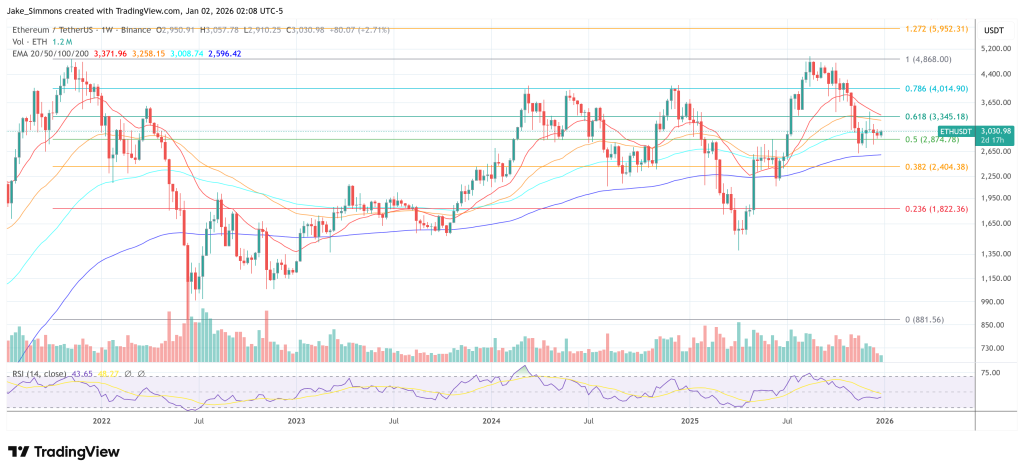
Featured image from YouTube, chart from TradingView.com
editing process for focuses on providing thoroughly researched, accurate, and unbiased content. We adhere to strict sourcing standards and each page is diligently reviewed by our team of top technology experts and seasoned editors. This process ensures the integrity, relevance, and value of the content for readers.


