


As market sentiment continues to deteriorate, Ethereum is increasingly struggling to maintain a compelling bullish narrative. Price action remains fragile, and more and more analysts are openly discussing the possibility of Ethereum shifting into a broader bear market phase.
Repeated failures to maintain upward momentum have undermined confidence, and risk appetite across cryptocurrency markets continues to decline. As volatility persists and capital rotates defensively, ETH is at the center of a debate between structural weaknesses in its price and resilience beneath the surface.
According to a recent CryptoQuant report, the current state of Ethereum reflects a noticeable shift in supply behavior across exchanges. The Exchange Supply Ratio (ESR), which tracks the percentage of ETH held on centralized trading platforms, has been steadily decreasing across all major exchanges.
This trend signals that a smaller portion of the circulating supply is immediately available for sale, which is an important factor when assessing supply and demand dynamics.
Historically, falling foreign exchange balances have meant less selling pressure as investors move assets into self-storage or long-term storage instead of preparing them for liquidation. In the current environment, these structural changes add nuance to the bearish narrative.
Exchange supply decrease signal structure change
The report highlights a marked decline in Ethereum’s Exchange Supply Ratio (ESR), reinforcing the view that supply dynamics are quietly shifting beneath the surface. Across all platforms, ESR dropped to around 0.137, one of the lowest since 2016.

This continued decline reflects the steady outflow of ETH from exchanges to external wallets, indicating a decreasing tendency to sell immediately and an increasing preference for long-term holding. Historically, similar patterns have emerged during reconcentration phases or transition periods of heightened volatility, often preceding more stable price action.
This trend has become more evident on Binance, where the ESR has decreased to approximately 0.0325. As the most liquid exchange, Binance balances serve as a key indicator of short-term supply conditions. Continued withdrawals of ETH from wallets indicate a meaningful decline in spot sellable supply, indicating heightened trader caution rather than aggressive distribution.
At the same time, Ethereum is trading near $2,960, an intermediate level that reflects a temporary balance between buyers and sellers. The combination of reduced supply on exchanges and relatively stable prices suggests that the market is not under significant selling pressure.
Instead, we appear to be entering a phase of liquidity absorption and strategic reallocation, where participants are reducing their exposure to short-term trading and preparing for potential changes in market structure.
Ethereum price is struggling below key trend levels.
The daily ETH chart highlights a structurally weak market despite near-term stabilization. Ethereum continued to print lower highs after failing to hold above the $3,200-$3,300 area, confirming the loss of bullish momentum since late October. Prices are currently trading in the $2,850-$2,900 region, a zone that has acted as a short-term demand source but lacks strong follow-through from buyers.
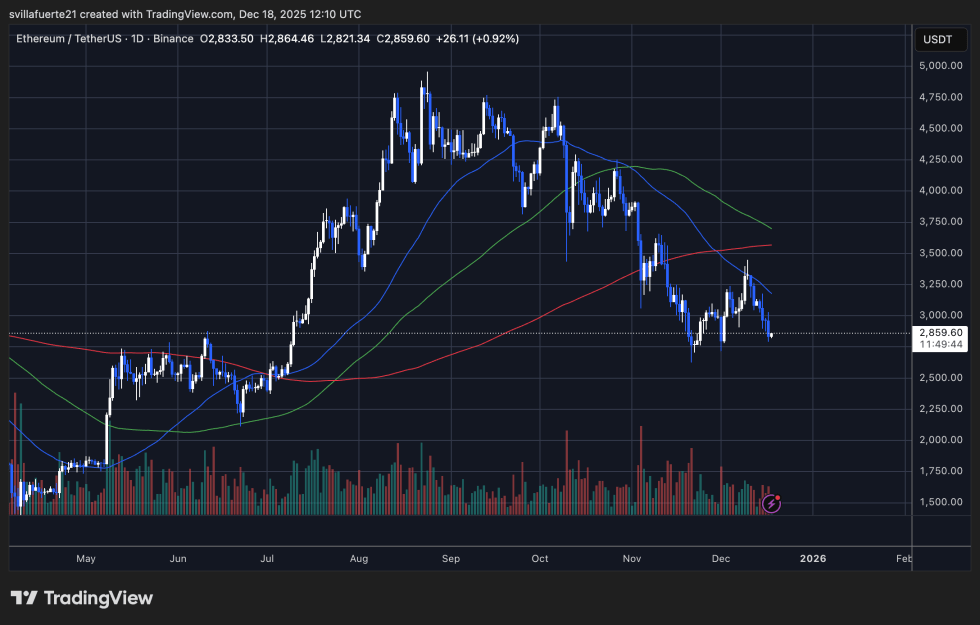
From a trend perspective, ETH remains below its short- and medium-term moving averages. The 50-day moving average has rolled over and is currently acting as dynamic resistance, and the 100-day moving average is also trending lower.
The 200-day moving average appears higher, reinforcing the idea that Ethereum has transitioned from a trending market into a correction or distribution phase. As long as the price remains below this level, the rally is likely to be sold off rather than extended.
Volume dynamics support this view. The recent bounce occurred on relatively weak volume compared to the heavy selling seen during previous declines, suggesting reactive short selling rather than new demand.
Structurally, ETH needs to regain and hold above the $3,100-$3,200 range to rebuild strength. Failure to do so risks tilting towards continued consolidation or a deeper correction zone with lower support levels.
Featured image from ChatGPT, chart from TradingView.com
editing process for focuses on providing thoroughly researched, accurate, and unbiased content. We adhere to strict sourcing standards, and each page is diligently reviewed by our team of top technology experts and seasoned editors. This process ensures the integrity, relevance, and value of the content for readers.


