


Ethereum is trading below $3,000 as it attempts to recover and raise key structural levels needed to signal the start of a recovery. So far, those efforts have failed. Prices are constrained by ongoing resistance and market confidence continues to deteriorate.
Although a short-term bounce has been seen, most analysts and investors expect the broader downward trend to continue, arguing that Ethereum lacks the demand and momentum needed to sustain a meaningful reversal. Sentiment has turned very pessimistic, with traders increasingly preferring further downside to recovery.
On-chain and technical data support this cautious outlook. A recent CryptoQuant report found that after Ethereum's sharp decline from its $4,800 highs, the price has been stuck in a narrow range centered around the $2,800 level for nearly a month. The district has virtually turned into market purgatory. Bulls have not had the confidence needed to reclaim higher highs, while bears have repeatedly failed to force a decisive break below support.
The result is prolonged volatility compression. As price action intensified, widespread indecision and lack of direction emerged among market participants. Historically, this compression often precedes rapid movement, but its direction remains uncertain.
Muted Layer 2 flows reflect deadlock in Ethereum.
A recent report from CryptoOnchain highlights that Ethereum’s price stagnation is closely reflected in its on-chain behavior. Weekly ETH netflows on Arbitrum, one of the most important Layer-2 networks on Ethereum and a common proxy for smart money positioning and DeFi activity, are still quiet and very choppy.
Rather than showing a clear trend of inflows or outflows, the data reflects a market operating without strong conviction, reinforcing the idea that larger players are choosing to stay on the sidelines.
This lack of directional flow means that capital is not moving in or out of the ecosystem aggressively. Instead, investors appear to be waiting for clearer macroeconomic signals or decisive changes in market structure before investing.
In previous cycles, continued expansion of Arbitrum netflow often coincided with periods of new risk appetite or decisive trend changes. The current state of inactivity stands in sharp contrast to this environment.
The coordination between compressed price action around key support levels and dormant on-chain activity represents the accumulation of latent energy within the market. Ethereum is effectively being coiled. This balance can persist for long periods of time, but it is rarely resolved quietly. When your balance is off, your movements tend to become fast and powerful.
Arbitrum netflow is now an important indicator to watch. The sudden and sustained expansion of flows could serve as an early sign that this prolonged phase of indecision is nearing resolution, potentially setting the direction for Ethereum's next major move.

As downward pressure continued, Ethereum stabilized near $3,000.
Ethereum is trading near the $2,970 level on the daily chart, attempting to stabilize after a prolonged decline from the $4,800 highs recorded earlier this cycle. Recent candles are showing a modest attempt at recovery, but the broader structure remains fragile. ETH continues to make lower highs and lower lows, indicating that despite the short-term relief bounce, the bearish momentum has not yet been negated.
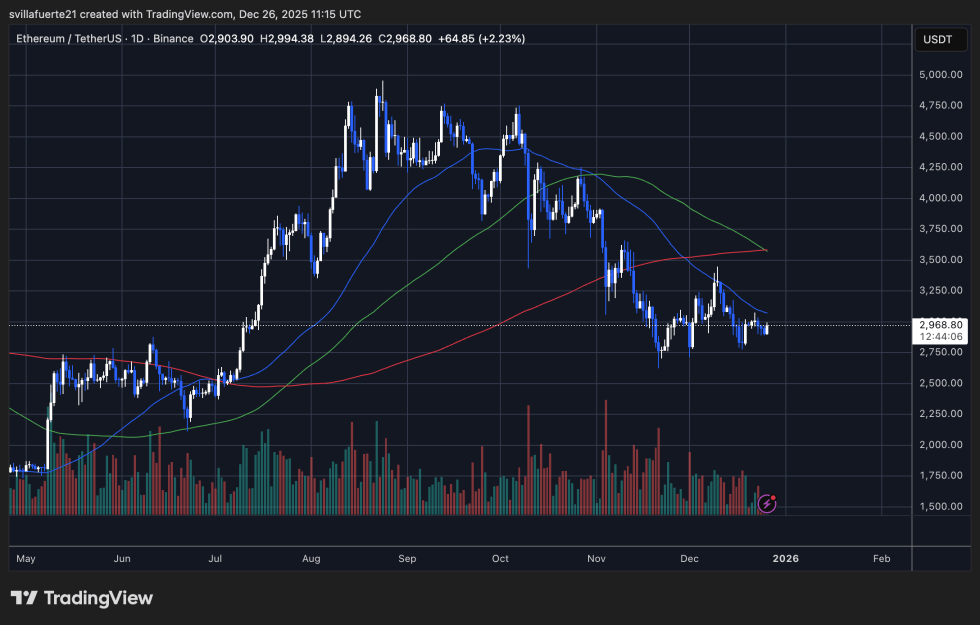
Technically, the price remains below key daily moving averages. The faster moving average rolls over sharply and acts as immediate resistance, while the 111-day and 200-day simple moving averages converge in the $3,300-$3,600 range. This cluster forms a zone of excessive overhead supply, limiting the potential for sustained upside unless volume and momentum expand meaningfully.
The recent bounce from the $2,800-$2,900 region has helped Ethereum avoid a more severe collapse for now. However, these movements occurred in relatively small volumes of transactions, suggesting a lack of buyer confidence. In contrast, the initial lower leg was accompanied by strong selling pressure, reinforcing the idea that the dominant trend is still down.
From a structural perspective, the $2,800 level remains an important support level. A decisive break below this area is likely to accelerate losses and confirm the continuation of the weakness. Conversely, for Ethereum to change momentum, the price would need to recover to $3,200-$3,300 and remain above the average daily decline.
Featured image from ChatGPT, chart from TradingView.com
editing process for focuses on providing thoroughly researched, accurate, and unbiased content. We adhere to strict sourcing standards, and each page is diligently reviewed by our team of leading technology experts and seasoned editors. This process ensures the integrity, relevance, and value of the content for readers.


