

Main highlights
- In the latest podcast, Tomasz Kajetan Stańczak revealed that developers will focus on: L1 scaling and organizational privacy in 2026
- Previously, Vitalik Buterin urged the community to focus on long-term goals instead of following the latest trends.
- Two major hard forks, Gramsterdam in mid-2026 and Hegota in late 2026, are designed to enhance Ethereum’s capacity.
In a recent interview on the ETHPanda Talk Podcast, Tomasz Kajetan Stańczak, the newly appointed co-executive director of the Ethereum Foundation, shared important details about new developments next year in 2026.
Tomasz Stanczak: Ethereum will focus on L1 scaling and organizational privacy in 2026
In an interview with ETHPanda Talk, Nethermind founder Tomasz Stanczak revealed that while researcher Dankrad Feist believes L1 scaling is still in its infancy, Ethereum is shifting its focus to faster… pic.twitter.com/WqHGVOg7QO
— Wu Blockchain (@WuBlockchain) January 2, 2026
Stańczak, founder of leading development team Nethermind, said that while layer 1 scaling remains an “unfinished” challenge, as Ethereum researcher Dankrad Feist pointed out, the foundation is now focusing its new year on two key areas, including faster transactions and improved privacy features.
These priorities will help meet the growing demands of institutional users who require both confidentiality and secure payments.
Tomasz Kajetan Stańczak's statement signals a new year strategy in which developers plan to balance enterprise-level requirements with scalability. His move from bootstrapping Nethermind, where he has contributed to important projects such as Flashbots and the Starknet Foundation, to a leadership role at the Ethereum Foundation signals a concerted effort to streamline key developments. It also plans to make it compatible with new technologies such as artificial intelligence.
This interview started a discussion in the crypto community about the evolving role of foundations.
Vitalik Buterin urges renewed focus on decentralization and resilience
Ethereum co-founder Vitalik Buterin has also been vocal about the important evolution of the network. In a talk at Devconnect Buenos Aires in late 2025, Buterin shared a number of upcoming Ethereum Improvement Proposals (EIPs) aimed at safely increasing the network's capacity while maintaining its decentralized nature.
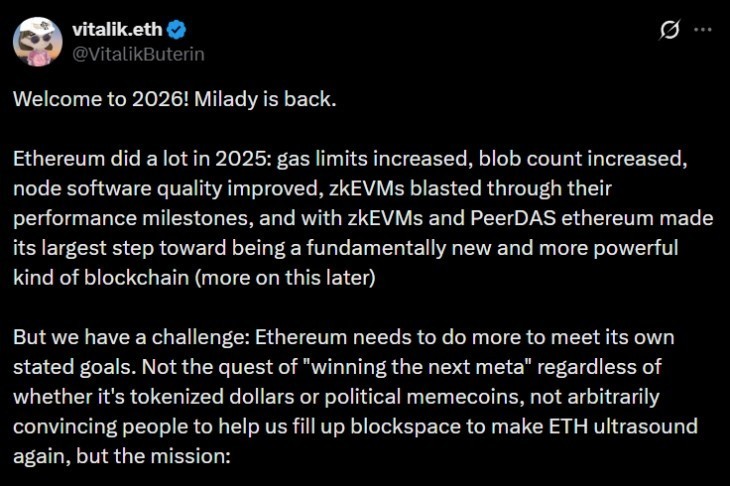
(Source: Vitalik Buterin of X)
Buterin primarily highlighted proposer-builder separation (PBS) and block-level access lists (BAL) as major upgrades that will ensure gas limits can be raised by the end of 2026 and make the network stronger.
Vitalik Buterin has issued a grave warning as 2026 begins, urging the community to refocus on Ethereum's original plan as a censorship-resistant “world computer.” He argued that without built-in privacy protections, users could flee to centralized alternatives that better protect their financial data.
Buterin also introduced practical “walk-away testing” for applications. This test raises questions about whether they will continue to work if the original developer is gone or if a major centralized service like Cloudflare fails.
Separately, he raised major concerns about quantum computing, warning that current elliptic curve cryptography could be broken by the 2028 US presidential election. Therefore, there is an urgent need to upgrade quantum performance within four years.
In a statement, he urged the community to focus on key goals rather than chasing the latest trends. he said:Ethereum needs to do more to achieve the goals it has set for itself. Whether it's tokenized dollars or political meme coins, it's not a quest to 'win in the next meta'. ”
“zkEVM has exploded past performance milestones, and with zkEVM and PeerDAS, Ethereum has taken its biggest step towards a fundamentally new and more powerful type of blockchain,” he said.
Glamsteldam and Hegota hard fork
In its latest revelation, the Ethereum team revealed two major hard forks planned for 2026.
The first one is known as ““Gramsteldam” is planned for mid-2026. This upgrade focuses on dramatically improving overall execution. Parallel transaction processing will be introduced and the layer 1 gas limit will be significantly increased from 100 million towards 200 million. With this, validators begin to move towards verifying zero-knowledge (ZK) proofs.
These changes, including the implementation of EIP-7928 for block access lists, are expected to increase Layer 1 transaction capacity toward 10,000 transactions per second (TPS). Increasing the number of data “blobs” per block further supports layer 2 networks.
The second fork, currently called “Hegota,” is targeted for late 2026. This upgrade is expected to develop basic privacy primitives directly into the protocol and improve censorship resistance through mechanisms such as FOCIL to ingest transactions more quickly.
Also read: Ethereum network sees changes in staking behavior as entry queues grow larger than exits


