

International credit rating agency Fitch Ratings has warned that it could negatively rate U.S. banks with “significant” cryptocurrency exposure.
In a report published on Sunday, Fitch Ratings argued that while cryptocurrency integration has the potential to increase fees, yields and efficiency, it also poses “reputational, liquidity, operational and compliance” risks for banks.
“Issuing stablecoins, tokenizing deposits, and leveraging blockchain technology will give banks the opportunity to improve customer service. They will also be able to leverage the speed and efficiency of blockchain in areas such as payments and smart contracts,” Fitch said, adding:
“However, it could lead to a negative reassessment of the business models and risk profiles of U.S. banks with concentrated digital asset exposure.”
Fitch said that although regulatory advances in the United States are paving the way for a safer crypto industry, banks still face several challenges when dealing with cryptocurrencies.
“However, to properly realize the revenue and franchise benefits, banks will need to adequately address challenges such as the volatility of cryptocurrency values, the anonymity of digital asset owners, and the protection of digital assets from loss or theft,” Fitch said.
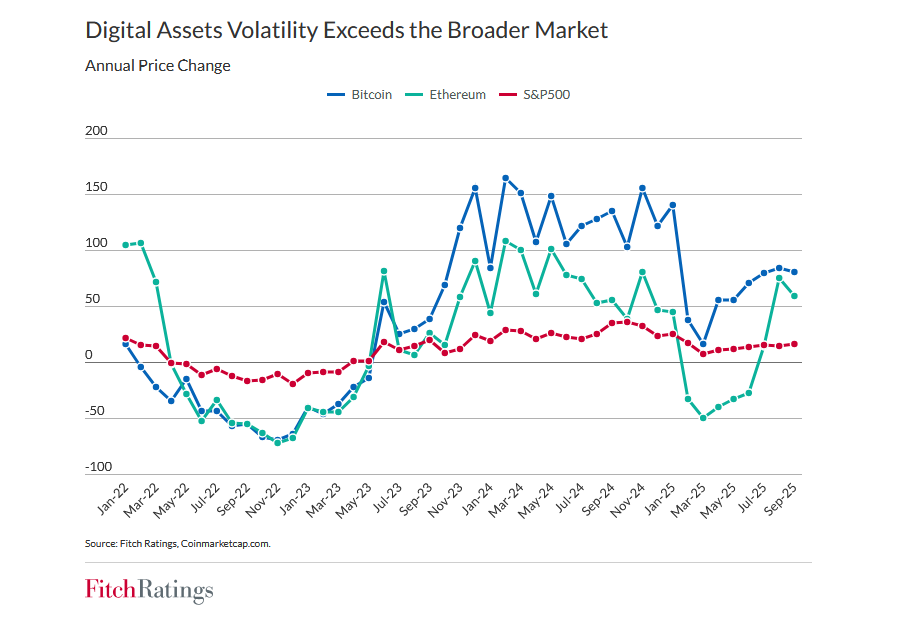
Bitcoin and Ether volatility vs. S&P 500. source: Fitch rating
Fitch Ratings is one of the “big three” credit rating agencies in the United States, along with Moody's and S&P Global Ratings.
Ratings from these companies can be controversial, but they carry significant weight in the financial world and influence how companies are perceived and invested in in terms of their economic viability.
Therefore, Fitch's downgrade of banks with significant exposure to cryptocurrencies could lead to lower investor confidence, higher borrowing costs, and challenges to growth.
The report highlighted that several large banks are involved in the crypto sector, including JPMorgan Chase, Bank of America, Citigroup, and Wells Fargo.
Fitch highlights systemic risks of stablecoins
Fitch argued that the explosive growth of the stablecoin market, especially if the market becomes large enough to impact other sectors and institutions, could pose other risks.
“Financial system risk could also increase if stablecoin adoption grows, especially if it reaches sufficient levels to impact the U.S. Treasury market.”
Related: Cryptocurrency, TradFi sentiment improves: Will Bitcoin traders be able to eliminate over $93,000 of short interest?
Moody's also highlighted the potential systemic risks of stablecoins in a report at the end of September, arguing that widespread adoption of stablecoins in the US could ultimately threaten the legitimacy of the US dollar.
“High penetration of stablecoins, particularly those linked to the US dollar, could weaken monetary transmission, especially if pricing and settlement are increasingly done in non-domestic currencies,” Moody's said.
“This creates cryptographic pressures similar to informal dollarization, but with increased opacity and reduced regulatory visibility,” it added.
magazine: When privacy and AML laws conflict: Impossible choices for encryption projects


