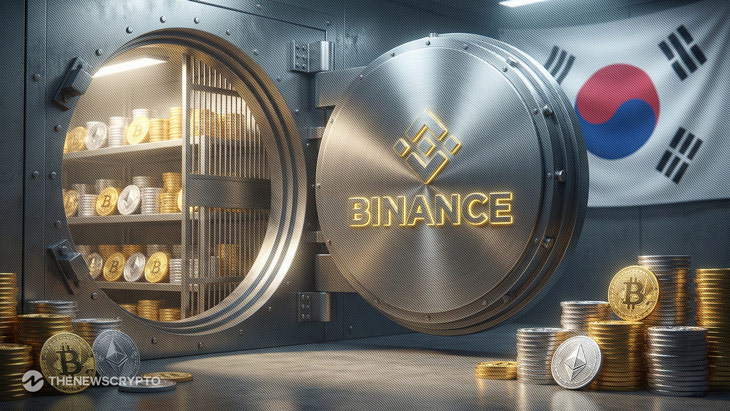
- Binance is strengthening its Korean strategy through the involvement of Gopax.
- GoFi's development signals further product expansion in the region.
- Regulation and local partnerships shape exchange competition.
Binance is strengthening its presence in South Korea by strengthening its position around the local exchange Gopax and the GoFi ecosystem. The move marks a calculated effort to gain a stronger foothold in one of Asia's most heavily regulated but highly active crypto markets.
This comes as crypto regulation trends in Asia become increasingly strict and exchanges recognizing the growing trend are expanding into the region. One country that stands out is South Korea. Participation levels are very high in South Korea, where the adoption of digital assets has become part of the culture.
Binance has identified opportunities despite these obstacles and, rather than moving strictly offshore and working with local infrastructure and platforms, has regulated its position and increased its relevance despite these current obstacles.
Gopax becomes the main gateway
Gopax appears to be playing a key role in Binance's expansion into South Korea. Gopax will likely be able to access local markets and users that are difficult for global exchanges to penetrate. Therefore, a new level of cooperation with Gopax will allow Binance to gain market influence that cannot be achieved by going head-to-head with regulators.
In this regard, GoFi proves that Binance wants to grow beyond spot market trading. It remains to be seen how regulators will define product boundaries, but lending, staking, or yield-related services could be next. Therefore, Binance positions itself as an extended provider of financial services, rather than just a trading venue.
This structure allows Binance to remain flexible. Adapt to local compliance while leveraging global liquidity and technology infrastructure.
Competition in a tough market
South Korea's cryptocurrency market does not function like it does in more relaxed jurisdictions. Additionally, exchanges must work closely with banks, maintain real-name accounts, and meet strict anti-money laundering requirements. These are barriers that reduce foreign entry, but reward those who build local alliances.
That is the very reason why Binance is partnering with Gopax. Rather than being actively pushed from the outside, exchanges are integrated into the ecosystem. Such strategies reduce friction while building long-term trust.
Global context and evolution of exchange
Media reports highlight that major exchanges are moving towards regional partnerships rather than purely global expansion. Regulation now drives growth as much as technology and liquidity.
This also applies to Binance's Korean model. This exchange offers global scale with local execution. This format could become the future standard for the existence of large exchanges within a regulated environment.
Strategic positioning for the future
Binance doesn't just compete on trading volume. It is increasing its structural presence in South Korea. Partnerships, product stacking, and compliance alignment are all part of the equation. Of course, there are access points that Binance gains from partnering with Gopax, but there is also the depth of the product that GoFi offers.
If this strategy is effective, Binance will consolidate its position in the Asian market without facing confrontational attacks from regulators. Binance also proves that integration, not confrontation, is the key to expansion for financial exchanges around the world.


