
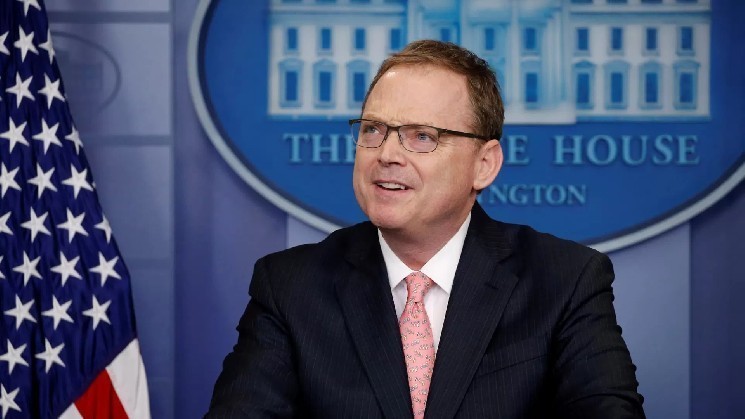
Ahead of this week's Fed interest rate meeting, White House National Economic Council Director Kevin Hassett, who is widely seen as a potential candidate to become the new Fed chairman, delivered a memorable message on CNBC's Squawk Box show about monetary policy, inflation, the “affordability” agenda, President Donald Trump's economic and artificial intelligence plans, and more.
Hassett said current Chairman Jerome Powell has been “running the Federal Open Market Committee (FOMC) well” and believes a 25 basis point rate cut is appropriate at this meeting. Hassett recalled that committee members seemed “deeply divided” recently, and noted that Powell “managed to rally” the committee toward a middle ground indicated by futures markets. But Hassett declined to provide numerical guidance on potential interest rate paths, saying, “We still have incomplete data due to the government shutdown, and we need to look at successive employment reports. It would be irresponsible to commit for six months from now.”
Hassett said that inflation, which remains hovering around 3%, was “the fundamental issue that everyone is thinking about” and that discussions were increasingly centered around “affordability”. Hassett argued that 20% to 23% of the price increase occurred during the Biden administration, noting that real living standards have nevertheless gradually recovered this year and the average American's purchasing power will increase by about $1,200 by 2025.
Hassett pointed out that real wages have risen by about 2.5% annually in recent months, which he argued reflects a “positive supply shock.” He argued that just as productivity gains from information technology were a factor in the 1990s, today artificial intelligence (AI) and productivity advances can support growth while alleviating price pressures. Still, he added, “inflation hurts everyone in the economy. The last election was primarily a vote on inflation.”
Hassett explained that the Trump administration's “affordability” agenda is being addressed not only through pricing but also through funding conditions. He said one of the White House's goals is to further lower interest rates on mortgages and auto loans through Fed action. He noted that trends in long-term interest rates and the 10-year Treasury yield are sensitive to Fed communications, as are changes in market inflation expectations. Nevertheless, he said the bond market is in a “much better place” than at the beginning of the year, and there is room for further reductions in 10-year Treasury yields in a scenario where growth and inflation decline.
Hassett said the White House will announce “a lot of positive news” on the economic front this week, noting that about 30 of the trillions of dollars in new factory and investment announcements announced during the Trump administration are now at the groundbreaking stage. He argued that tax policy would also change voters' perceptions, noting that thanks to measures such as tax exemptions on tips and overtime, the average worker could expect to earn an additional $1,600 to $2,000 next year, a significant portion of which will be reimbursed at the beginning of the year. “At the end of the day, people are going to look in their wallets and say, 'My life is better because of this president,'” Hassett said, recalling that President Trump's deep tax cuts in his first term increased household income by $6,500.
Hassett also mentioned an executive order on artificial intelligence that President Trump is expected to sign this week. Referring to President Trump's message on Truth Social that “if you want to win the AI race, there has to be a single rulebook,” Hassett said some states want to regulate AI companies “for life” and impose steep fines for mistakes, which could be a way for state governments on the brink of bankruptcy to extract revenue from tech companies. Hassett said President Trump would not tolerate this. “The executive order he plans to sign will create one clear set of rules for U.S. AI companies across the country. They won't have to get 50 different approvals in 50 states.”
He spoke about the possibility of becoming Fed chairman.
When asked about the possibility of becoming Fed chairman, Hassett declined to give a direct answer, but said he supports President Trump “100%” and is ready to serve regardless of the decision. Hassett argued that contrary to market arguments, Trump faces “not a hard choice, but a guaranteed good choice.” He described current Fed Director Christopher Waller as “one of the greatest monetary policy theorists of the past generation,” Michelle Bowman as “the best regulator in the world,” and Kevin Warsh as “one of the most experienced Fed directors.” He added: “Whatever name the president chooses, he will make a good decision.” Hassett described the Trump administration as “the most transparent administration I've ever seen,” adding that the president expressing his thoughts directly and publicly brings clarity to both the markets and the teams he works with.
*This is not investment advice.


