


Content is reviewed by trusted editors and experienced industry experts to maintain excellent editorial standards.
- ObjectID expands IOTA's real-world applications by introducing new on-chain verified products that users can explore by scanning the QR on the Lizard Medical board.
- IOTA and ObjectID take blockchain real-world adoption to a new level, demonstrating ecosystem momentum.
IOTA, the decentralized blockchain infrastructure, is moving towards real-world adoption as ObjectID launches an on-chain verified product. IOTA also confirmed that ObjectID is part of its efforts to bring the real world on-chain.
Debut of ObjectID on-chain verified product
In a post on X, ObjectID announced the launch of the first physical product tracking decentralized application (dApp) on the IOTA network.
In the post, ObjectID shared a linked dApp page created by Lizard Medical Italy that displays details of a specific ObjectID, a unique cryptographic hash.
Reply to IOTA post recognized This achievement is meant as a practical step forward that reflects a broader mission in real-world adoption.
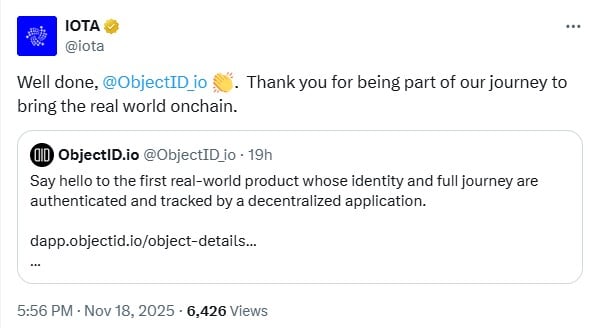
ObjectID Product Announcement Spotlight | Source: IOTA
The complete process of a new product includes its creation, transfer of ownership, and updating. These are immutably recorded on IOTA's ledger using verifiable credentials and smart contracts written in the Move language.
Users access the dApp by scanning the product's QR code, which verifies the creator's decentralized identifier (DID), a W3C standard digital ID associated with the lizardmed.it domain. This proves that the issuer controls the domain and prevents counterfeiting. Therefore, it is not possible to forge an identity without accessing the domain.
Essentially, ObjectID turns physical objects into smart assets with a verifiable blockchain passport that can be accessed with a simple QR scan.
ObjectID strengthens its relationship with IOTA
ObjectID is a blockchain-based platform that provides a suite of solutions tailored to ensure traceability, authenticity, and product security and meet the diverse needs of industries.
It focuses on assigning a tamper-proof digital identity to physical products, even in complex and distributed production processes. Key features include blockchain-based traceability, controlled updates, end-to-end visibility, historical data archiving, and more.
as highlighted In our previous article, we learned that ObjectID is built on the IOTA blockchain and takes advantage of its fee-free, scalable, and energy-efficient nature. tangle technology. This enables zero-cost transactions, real-time updates, and integration with IoT devices without the need for wallets or gas fees.
Also, ObjectID has filed a patent We are partnering with the European Patent Office on a decentralized product ID system built on the IOTA mainnet. The platform was intended to provide an easy way for manufacturers to assign a unique digital twin to each physical item and record all changes on an immutable ledger.
Meanwhile, the IoT industry is poised for explosive growth, with an estimated 25 billion connected devices by 2026 and 40 billion by 2030.
ObjectID is at the forefront of this revolution because it seamlessly integrates with physical objects. Therefore, the launch of an on-chain verified product represents not only an innovation, but also a concrete leap into real-world blockchain applications.
Similarly, IOTA continues to expand its ecosystem, accelerating the transition from centralized databases to a decentralized and trusted digital economy. as outlined In a recent blog post, IOTA introduced a new trust framework design to support cross-industry data validation and asset exchange.


