

Decentralized perpetual exchanges are quietly racking up nine-figure monthly trading volumes as traders continue to move leverage-heavy activities from centralized venues to on-chain.
Decentralized Perps platform sees sustained growth in trading activity
Decentralized perpetual exchanges, often referred to as Perp DEXs, are a growing area of decentralized finance (DeFi) that allow traders to speculate on the price of assets such as Bitcoin or Ether without outright ownership.
Instead of spot trading, users open leveraged long or short positions using perpetual contracts (derivatives with no expiry date), which are executed entirely by smart contracts. Unlike centralized exchanges, PERP DEX is not stored.
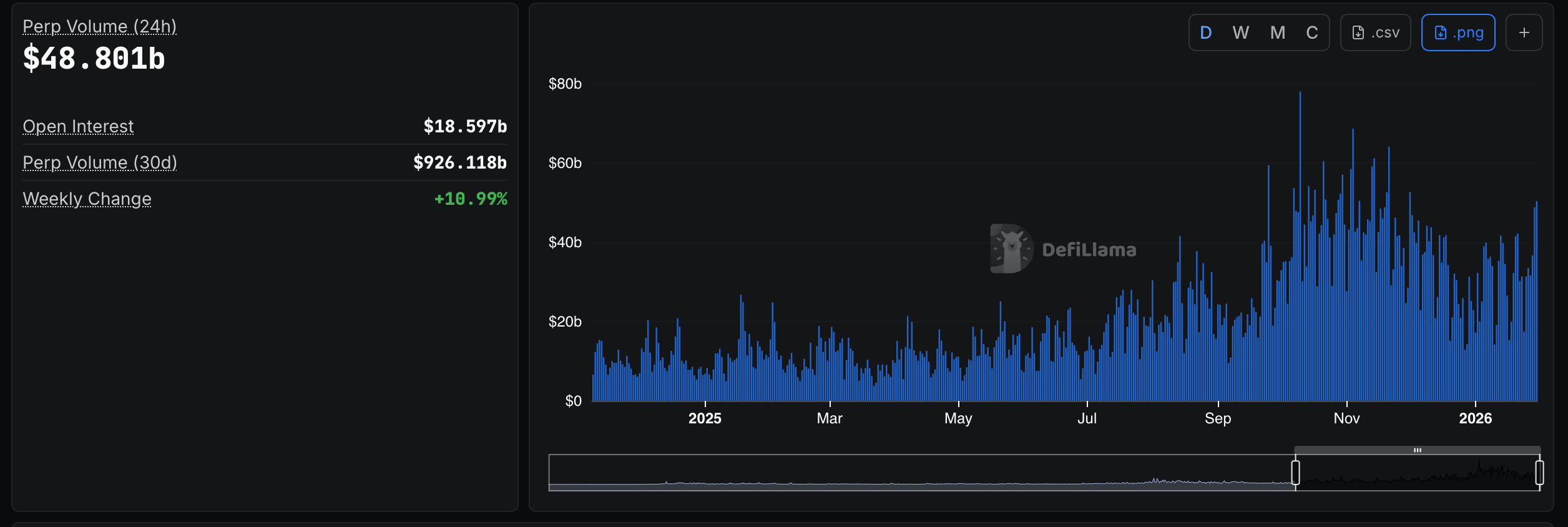
Source: DEX statistics from defillama.com.
Essentially, traders connect to their wallets, post collateral directly to smart contracts, and are always in control of their funds. Margin requirements, funding rates, clearing, and P&L accounting are enforced on-chain, eliminating the need for trusted intermediaries and reducing traditional counterparty risk.
This model is proving increasingly attractive. Decentralized PERP trading volume reached $48.8 billion in the past day, with 30-day trading volume of $926.1 billion, reflecting a weekly increase of 10.99% since early 2026, according to the latest data from defillama.com. Open interest (OI) across the platform currently stands at $18.6 billion, indicating sustained speculative engagement rather than a temporary spike in activity.
But the real story is concentration. A small group of platforms is responsible for most of the 30-day activity, with Hyperliquid resolutely leading the way. The popular on-chain PERP venue recorded $183.6 billion in 30-day trading volume, far outpacing its competitors. The $7.9 billion OI further highlights how deeply embedded the company is in leveraged cryptocurrency trading.
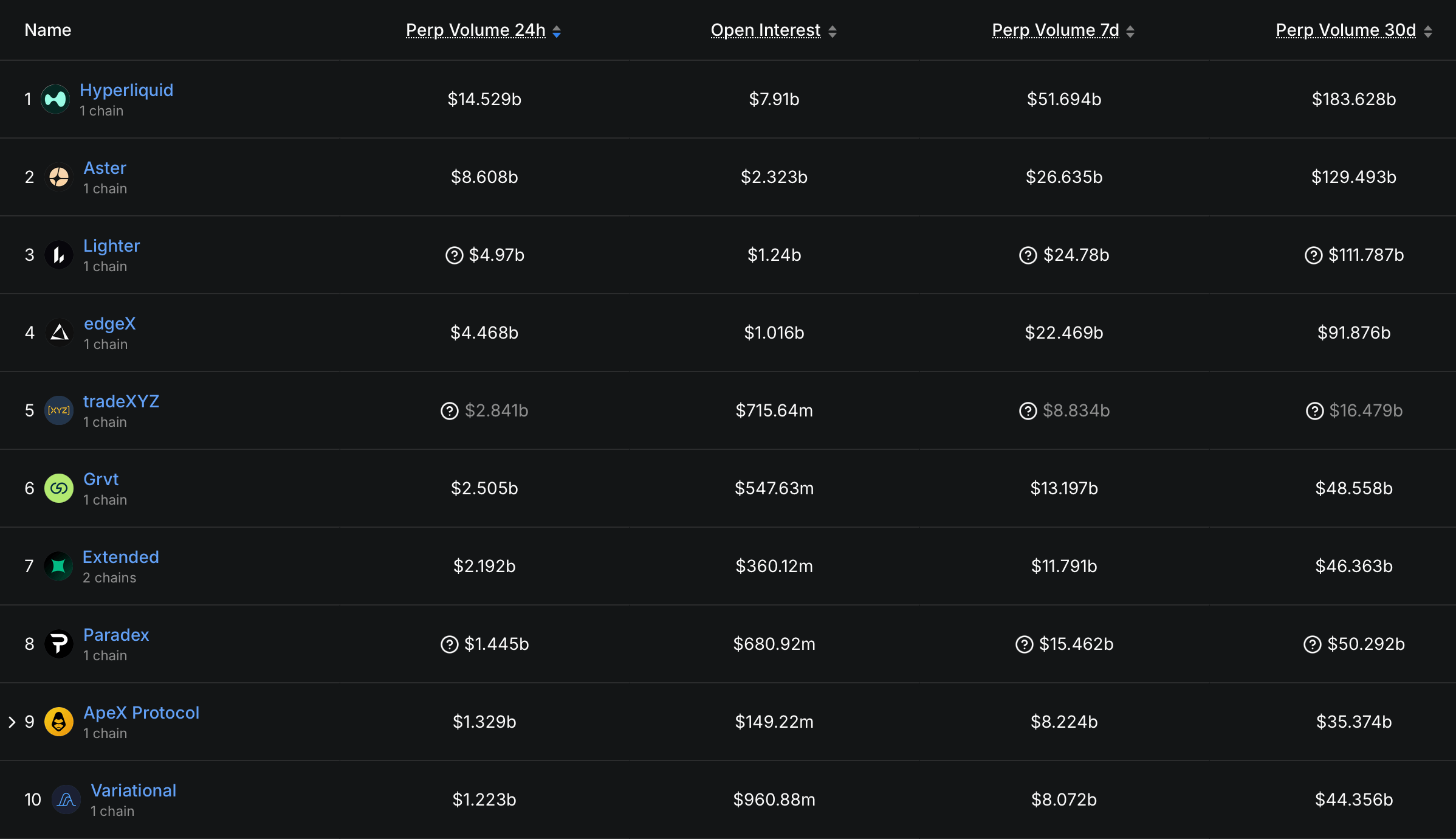
Source: DEX statistics from defillama.com. Statistics for 30 days from January 1st to January 30th, 2026.
Aster came in second with $129.5 billion in 30-day volume and $2.3 billion in open interest, followed by Writer with $111.8 billion. EdgeX is a close second with $91.9 billion, while TradeXYZ is in the top five with $16.5 billion over the same period.
The bottom half of the top 10 remains seriously large. Grvt recorded a 30-day trading volume of $48.6 billion, Extended with $46.4 billion, Paradex with $50.3 billion, ApeX protocol with $35.4 billion, and variational closing the list with $44.4 billion. In total, the top 10 Perp DEX platforms account for the majority of all decentralized Perp trading activity in this space.
Also read: Coinbase turns predictions into trades with new US prediction market
The broader upward trend from 2025 to 2026 reflects structural changes. After years of currency collapse, regulatory pressure, and opaque balance sheets, traders seem increasingly comfortable executing risky strategies directly on-chain. Close to $1 trillion in trading volume in 30 days suggests that decentralized derivatives are no longer an experiment, but the infrastructure of today.
If current momentum continues, PERP DEX may soon rival mid-tier centralized derivatives exchanges. By offering a fundamentally different risk and custody model that aligns with the original promise of cryptocurrencies.
Frequently asked questions ❓
- What is a decentralized Perp DEX?It is a non-custodial exchange that allows users to trade perpetual futures directly from their wallets using smart contracts.
- Why is Perp DEX popular?It offers leverage, short selling, and transparency without the need to manage user funds.
- Which platform is leading in 30-day trading volume?Hyperliquid leads the decentralized Perp DEX with over $183 billion in 30-day trading volume.
- What is the current market size?In the past 30 days, the total trading volume of decentralized Perp reached approximately $926 billion.


