
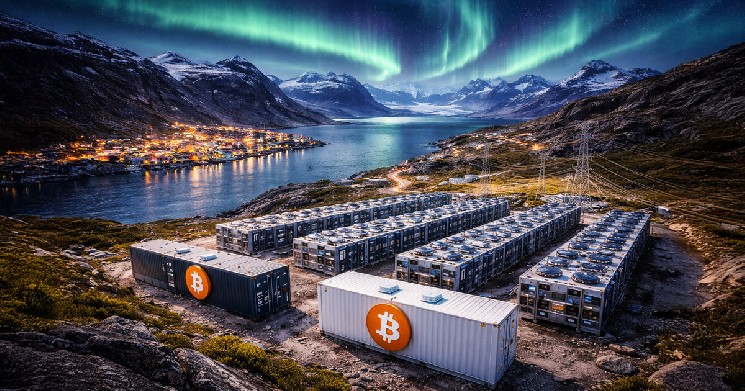
Talk of the US buying Greenland is returning to Washington, and miners are pursuing power projects on the island.
According to Reuters, the White House said the US purchase of Greenland was “actively discussed.”
A more practical watch for Bitcoin miners is Greenland's industrial power project.
How Greenland's hydropower translates into actual Bitcoin mining capacity
According to Naalakkersuuisut.gl, the Government of Greenland has announced that it plans to open a public tender in the second half of 2026 for the two largest hydropower plants for mapped industrial use, Tasselsiak (site 07.e) and Tarsaltuap Tasselsua (site 06.g).
Together, the two sites will be able to generate more than 9,500 gigawatt hours of electricity annually.
Mining calculations are easy.
According to Bitmain, Bitmain's Antminer S21 specifications list 200 TH/s at 3,500 watts, or approximately 17.5 joules per terahash.
Using a planned power efficiency value (cooling and overhead) close to 1.1, 1 megawatt of facility power is equivalent to approximately 0.052 exahash/second (EH/s) at 17.5 J/TH.
This means approximately 0.041 to 0.061 EH/s across the 15 to 22 J/TH efficiency band.
Greenland's installed base is much smaller than the bid's ambitions.
Nukissiorfiit's annual report reports that the company's total system hydropower capacity is approximately 91.3 MW, with an average electricity sales price of approximately DKK 1.81 per kilowatt hour in 2024.
Retail-style pricing at that level clearly does not correspond to the economics of the mining industry.
Large constructions therefore rely on industrial power purchase agreements or new-generation behind-the-meter supplies, rather than purchasing power like regular customers.
The lack of a national power grid narrows the path to scale.
According to Trapp Greenland, power plants typically serve towns and settlements as local systems with limited interconnections.
This pushes the earlier concept of “stranded” or surplus energy towards coexisting flexible loads in a given plant.
According to Greenland Review, Greenland's report discusses the use of surplus energy with a view to reducing energy costs.
If you can aggregate 5 to 25 megawatts behind the meter near your existing generator, the upper limit would be approximately 0.21 to 1.52 EH/s across the 15 to 22 J/TH band (approximately 0.26 to 1.30 EH/s at 17.5 J/TH).
This is good enough for pilots, but not enough to drive global network share.
The next tier is Nuuk's main hydroelectric power plant.
Expanding Bitcoin mining in Greenland: From surplus power testing to grid-level expansion
Buxefjord is planned to expand from 45 MW to 121 MW, with construction starting in 2026 and commissioning targeted for 2032, Nunagreen said.
The European Investment Bank's project pipeline refers to the construction of the approximately 76 MW Buksefjord-3 near an existing 45 MW power plant.
If an output of 50 to 121 MW is contracted to the miner, the electrical cap would be approximately 2.07 to 7.33 EH/s across the 15 to 22 J/TH band (approximately 2.6 to 6.3 EH/s at 17.5 J/TH).
This assumes that these megawatts are not absorbed by Nuuk's demand growth and electrification plans.
Two bids put Greenland in the discussion for gigawatts.
More than 9,500 GWh per year equates to approximately 1.08 gigawatts of average power when fully utilized.
This means that the power-limited hashrate is capped at approximately 44.8-65.7 EH/s across the 15-22 J/TH band (approximately 56.0 EH/s at 17.5 J/TH).
According to minerstat, the tracking site estimates Bitcoin's hash rate to be around 1.03 to 1.17 zetahashes per second (ZH/s), and minerstat's difficulty level is close to 148 trillion.
On this baseline, a fully utilized 1.08 GW mine would represent approximately 4-6% of today's network hash rate, a share that shrinks as the global hash rate grows.
Could capital connected to President Trump look to Greenland's surplus energy to expand Bitcoin mining?
Mining capitals linked to President Trump have already been formed, which is why Greenland's power calendar is attracting attention within the sector.
Hut 8 partnered with Eric Trump to launch American Bitcoin, combining Hut 8's mining operations with a group of investors that included Donald Trump Jr., but Hut 8 retained an 80% stake.
According to the company, American Bitcoin said that as of September 1, 2025, the installed hashrate has expanded to approximately 24 EH/s and the fleet efficiency is approximately 16.4 J/TH.
Using the same PUE 1.1 planned value, 24 EH/s means approximately 430 MW of facility power at 16.4 J/TH (approximately 460 MW at 17.5 J/TH).
This means that if the offtake is dedicated to mining and transmission and construction schedules are clear, the 1.08 GW of bid equipment could potentially power a Bitcoin-sized fleet in the United States multiple times if fully utilized.
Even in a “what if” sovereignty scenario, the constraints remain realistic.
Industrial hydropower requires multi-year construction, significant logistics, and long-term water withdrawals, and mines require resilient data links, spare parts, and the ability to import ASIC fleets.
Tasas said Greenland Connect connects Canada, Nuuk, Qakortok and Iceland with an undersea cable, but transmission to remote hydro basins is not resolved.
Clean, stable megawatts also face competition from other loads.
The International Energy Agency has warned that AI could increase demand for electricity from data centers, raising the opportunity cost of dedicating long-term renewable energy output to mining.
Diplomacy will shape funding conditions based on the “Trump Greenland Mine” argument.
According to Reuters, European officials stressed that Greenland's status is based on consent and sovereignty norms.
Greenland's bidding round, scheduled for late 2026, will set the baseline for large-scale Bitcoin mining from new hydropower on the island.
Why Greenland's energy economy and geopolitics matter for large-scale Bitcoin mining
However, if Greenland were to come under US jurisdiction and be treated as an energy enhancement zone rather than a small, fragmented power market, the renewable energy cap important for mining would shift from 1GW-class hydropower tenders to a focus on wind as well.
According to a systems study published in energy The technical potential of Greenland's onshore wind power, as indexed by ScienceDirect, is approximately 333 GW, which would generate approximately 1,487 TWh per year, assuming 20% of Greenland's ice-free area is available.
This corresponds to an average power generation of approximately 170 GW on an energy basis.
Production volumes fluctuate, requiring transmission, overbuilding, reduction, storage, and fixing to accommodate large loads 24/7.
Converting this energy-only cap to hashrate shows how far the “Trump’s Greenland mine” narrative can theoretically be pushed.
At 15-22 J/TH with a PUE of around 1.1, if the miners were able to absorb the average output as a flexible load, the average power generation of 170 GW would mean a hashing capacity of around 7.0-10.4 ZH/s, which is significantly higher than today's networks.
With the current hashrate around 1 ZH/s, acquiring enough mining machines to facilitate such a build would primarily be a theoretical exercise of potential forward-looking limitations.
Also, 10 ZH/s is not a “24/7 stable baseload” unless you add large sends, overbuilds, reductions, storage/fixing (or accept downtime/fluctuating operations). This is a ceiling based on average wind energy absorption, rather than providing guaranteed power every hour.
Yet, a rough linear extrapolation of the same study's land availability assumptions from 20% to 100% would imply approximately 7,435 TWh (average approximately 848 GW) per year, or approximately 34.8 to 51.7 ZH/s.
This is a cap based on physics and mapping, not a construction plan that takes into account siting, permitting, ports, roads, and HVDC requirements.
According to IRENA, the global average installed cost for new onshore wind power in 2023 was approximately $1,154 per kW.
This leaves 333 GW of turbines alone worth about $384 billion, excluding insurance, transmission, and infrastructure in the Arctic.
OneMiners is listing the Antminer S21 XP Hyd at 473 TH/s for $6,799. To utilize 333 GW, approximately 21,141,650 miners would be required, which would be approximately $143 billion.
However, this is just the cost of purchasing the ASIC. This does not include all-important costs such as transportation, customs/VAT, spares, racks/PSUs/networks, buildings, cooling/hydro loops, commissioning, etc., which can run into the tens of millions of units.
All told, an investment of about $427 billion would give the Greenland-based miner enough renewable energy-derived hashing power to control the $1.8 trillion Bitcoin network by more than 10 times, assuming the hardware is available (which it isn't). Or about $55 billion equivalent to today's network hash rate (not simply 1/10th, due to scaling).
These are all “back of the envelope” numbers with many caveats and assumptions, but the reality is that there is enough unused energy in Greenland to power the Bitcoin network many times over. With Starlink, you could probably build a major AI data center as well.


