
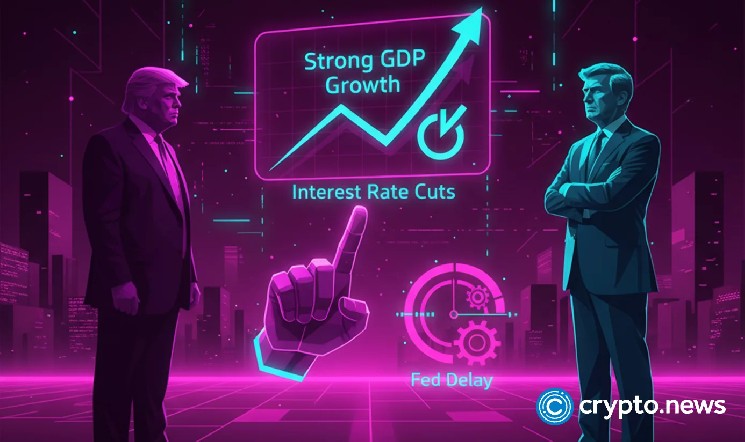
President Trump called for faster Fed rate cuts after GDP growth hit 4.3%, and Kevin Hassett cited productivity gains from AI as inflation risks prove to remain contained.
summary
- President Trump called for interest rate cuts even though GDP in the third quarter of 2025 exceeded expectations by 3.3%, arguing that strong growth should be rewarded, not suppressed.
- NEC veteran Kevin Hassett supports the cuts, pointing to AI-driven productivity and trade gains from tariffs as signs that inflation is manageable.
- Since Mr. Powell's term ends in May 2026, the market is focused on Mr. Trump's likely choice of the Fed and its impact on future U.S. monetary policy.
President Donald Trump called for interest rate cuts after stronger-than-expected U.S. economic growth, arguing that strong economic performance requires more accommodative monetary policy, according to a released statement.
Trump presses for interest rate cuts
This call comes after the GDP growth rate for the third quarter of 2025 was 4.3%, higher than the expected 3.3%. President Trump criticized the Fed's approach, saying that if the economy is doing well, interest rates should be lowered to encourage more growth.
President Trump's position stands in contrast to the Fed's current focus on curbing inflation. The president said strong markets should be rewarded with low interest rates and that raising rates during a period of growth would hurt the economy's potential.
You may also like: Pi Network price risks crashing on Christmas Day as unlocking of 8.7 million tokens looms
Former National Economic Council director Kevin Hassett expressed support for lowering interest rates. Hassett said in an interview with CNBC that the Federal Reserve has not been able to adjust quickly enough to accommodate economic growth. He cited increased productivity in sectors affected by artificial intelligence as evidence that inflationary pressures remain under control.
Hassett also cited trade policy, including tariffs, as a factor contributing to reducing trade deficits and overall economic growth. He said these factors support the need for the Federal Reserve to cut interest rates to maintain economic expansion.
The interest rate debate comes as the Federal Reserve prepares for a change in leadership. Federal Reserve Chairman Jerome Powell's term expires in May 2026, and President Trump is expected to announce his successor. Hassett has been mentioned as a potential candidate because he aligns with President Trump's positions on interest rates.
Mr. Hassett emphasized the importance of the Federal Reserve's independence and consensus-based approach, saying the Federal Open Market Committee should make decisions based on data rather than speculative inflation concerns.
The direction of US monetary policy is likely to depend on the stance of the next leadership. Market participants are closely monitoring developments regarding interest rate policy and personnel changes in the US Federal Reserve's leadership.
read more: Sanctions push Russia toward stricter, broader crypto rulebook


