


According to on-chain analyst James Check, Bitcoin could face as much a political as a technical crisis once powerful quantum computers emerge.
He cautions that the hard part isn't the math, but getting the Bitcoin community to agree on how to protect a coin that hasn't moved in years.
Risk of dormant supply
The report revealed that approximately 32.4% of all Bitcoin has remained static for the past five years, and nearly 17% has remained static for more than 10 years.
The stockpile contains addresses that publish public keys, making it a prime target if quantum attacks are put into practice.
Some analysts estimate that around 6-7 million BTC exists in these vulnerable formats. These holdings are already monitored by security experts.
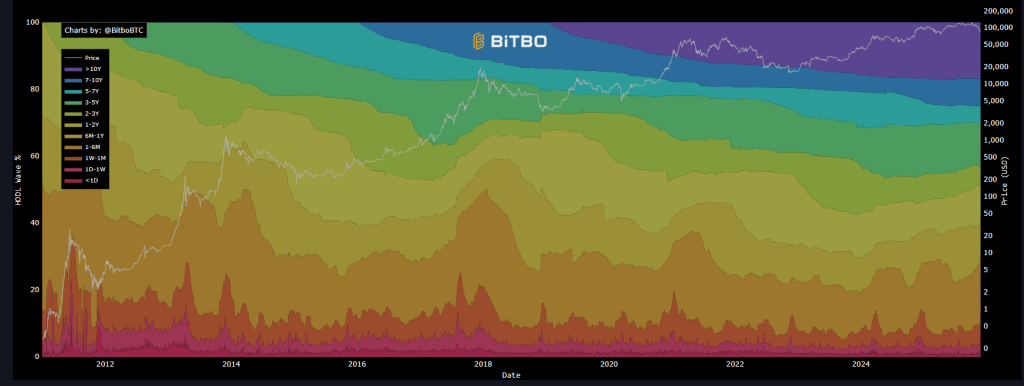
HODL Waves chart for Bitcoin, based on BitBo data.
Bitcoin uses elliptic curve signatures
Bitcoin’s current protection relies on ECDSA and Schnorr signatures. Researchers and standards organizations say these schemes could be broken by Scholl's algorithm once large enough quantum computers emerge.
The National Institute of Standards and Technology has approved several quantum-resistant signature schemes, and Bitcoin Improvement Proposal 360 mentions post-quantum options. However, adoption requires broad consensus across the network.
Allow old coins to return to the market.
There is no chance of reaching an agreement to freeze them, so let's focus on the technical aspects of quantum-secure wallets and let the market sort out the rest. https://t.co/7xOZRVYl5r
— _Checkmatey 🟠🔑⚡☢️🛢️ (@_Checkmatey_) November 23, 2025
Technical timeline and estimates
Today's quantum devices have approximately 1,000 physical qubits. Some researchers now say that a special machine with about 126,000 physical qubits could break the signature of an elliptic curve.
Others put the standard at about 2,300 logical qubits. These gaps are important because physical and logical qubits are not the same. Turning the former into the latter requires powerful error correction.
BTCUSD trading at $87,017 on the 24-hour chart: TradingView
Schedules vary, but a viable attack window is estimated to be in the late 2020s or early 2030s. Some scientists argue that the machine is unreliable and far from practical use, and that a serious threat is unlikely for at least 20 to 40 years.
Institutional initiatives and prudent companies
According to reports, some parties are already changing the way they handle Bitcoin. El Salvador reportedly split its 6,284 BTC reserves into 14 addresses to lower risk.
Major companies have listed quantum concerns in filings, and stablecoin operators have issued warnings about wallets that are inactive for long periods of time.
I think a lot of the confusion about quantum and Bitcoin is because everyone sees it as a technology issue, but what makes this issue particularly unique to Bitcoin is that the technology issue is secondary.
Quantum-proof Bitcoin is possible, but it doesn’t solve what to do with old coins
— Ceteris (@ceterispar1bus) November 23, 2025
politics can determine the outcome
James Cech argues that the main danger lies in governance. He believes it is “unlikely” that the community would agree to freeze or force transfer of coins whose owners do not move them themselves.
That political reality could leave millions of coins at risk even if a technical fix exists, he says. Some developers and industry players are calling for a faster response. Some think the switch can wait until a post-quantum standard is ready.
The debate has divided experts, with some calling for early transition plans and others arguing the threat is remote and manageable. Based on the report and the numbers above, the situation is clear. The risks are real, the dates are uncertain, and the biggest hurdle may be human consent rather than hardware.
Featured image from PostQuantum.com, chart from TradingView
editing process for is focused on providing thoroughly researched, accurate, and unbiased content. We adhere to strict sourcing standards, and each page is carefully reviewed by our team of top technology experts and experienced editors. This process ensures the integrity, relevance, and value of your content to your readers.


