

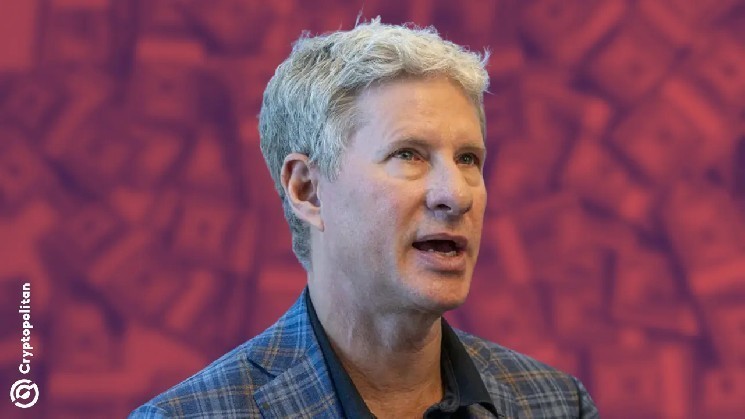
Chris Larsen just broke into the world's top 200 richest people, and it happened quickly. The move comes after the US government and Wall Street changed their stance on cryptocurrencies.
The Securities and Exchange Commission ended a five-year lawsuit against Ripple in August, removing a major burden from the company.
On Wednesday in San Francisco, investors associated with Fortress Investment Group and Citadel Securities invested $500 million in Ripple, valuing the company at $40 billion, according to Bloomberg. The timing was almost rude.
The new valuation and the roughly 9% increase in XRP this year propels Chris into billionaire territory with a net worth of $15.3 billion, putting him among the world's richest people for the first time.
Most of that wealth comes from an 18% stake in Ripple Inc. and 2.7 billion XRP tokens worth about $6.3 billion as of Wednesday. He also owns $1.8 billion in real estate and various investments.
The details were confirmed directly to Bloomberg. Chris, 64, who was born in San Francisco and raised in Cupertino, has been building his company since the 1990s, long before cryptocurrencies existed. He first went to San Jose State University to study aeronautics.
Chris turned to business and transferred to San Francisco State University, graduating in 1984 with degrees in accounting and business administration. He then worked as an auditor at Chevron and later earned an MBA from Stanford University.
start a company and build wealth
Chris first made some serious noise in 1996 when he co-founded E‑Loan, the first platform to display consumer credit scores online. He sold it to Popular Corporation nine years later for $300 million.
He then founded Prosper Marketplace, an institutional lending platform inspired in part by his wife's background in Cambodia. He left Prosper in 2012. A few months later, he co-founded OpenCoin, which became Ripple.
The company focused on cross-border payments using XRP. Chris led the company as CEO until 2016, when he moved to the role of Chairman.
His work now extends to local issues as well. Along with his wife, Lina Lam, he supports community projects in Cambodia, tackling climate change, food access, and rebuilding the San Francisco neighborhood.
The two founded the Khmer Buddhist Foundation, which is funding the construction of a new temple in San Jose. Locally, Chris has been politically active for many years. He funded San Francisco's private camera network to fight property crime and recently donated $9.4 million to help the city build a real-time police operations center.
Meanwhile, as reported by Cryptopolitan, Ripple has no plans to go public anytime soon. In response to questions on Wednesday, Ripple President Monica Long said there was “no plan, no timeline.”
Fate changes as the virtual currency market sways
While Chris climbs the billionaire rankings, his crypto trading shows the opposite energy. On Hyperliquid, one wallet opened two large short positions in Bitcoin and XRP, totaling $140 million.
The trader has now gained $3.1 million in about 9 hours. This wallet was funded with $7 million in USDC transferred through an Arbitrum wallet that was redeemed from a zero address, making its origin difficult to trace.
Observers are already speculating about insider knowledge. This reminds traders of the “Trump Insider Whale” who reportedly made nearly $200 million in short sales before the $19 billion liquidation crash on Oct. 10.
Despite the shorts being lined up, anyone linked to that wallet denied having inside information that's right Before former President Trump's tariff threats roiled the market.
Bitcoin is falling. It fell 7.4% to $96,794 in New York on Tuesday, falling below $100,000 for the first time since June. This is more than 20% below last month's all-time high. Ether has fallen by up to 15% this year, and some altcoins have fallen by 50%.
Many traders remained inactive after October's wave of liquidations. Open interest in Bitcoin futures remains low. Even if financing rates seem favorable, few people reach out for financing. Bitcoin is up less than 10% this year, trailing stocks and failing to hedge portfolios.


