
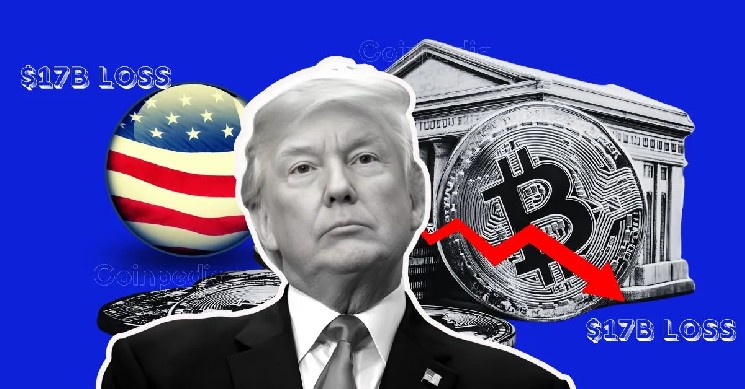
The United States risks falling behind in the global Bitcoin race as it waits for other countries to start accumulating Bitcoin before activating its own strategic reserves.
Experts have warned that Bitcoin could reach $1 million by 2033, and analysts are urging the US to act faster as countries like Pakistan prepare to buy Bitcoin to gain an advantage.
Bitcoin's sharp decline from its recent highs has challenged the dominant bullish narrative, with the market down more than $1 trillion in six weeks and Bitcoin down about 25-30% from its October peak amid rising U.S. interest rates, a stronger dollar and fading hopes for a short-term Fed rate cut.
Amid this widespread market disaster, the US position in the global Bitcoin race has come back into focus after entrepreneur Mike Alfred suggested the US would not start accumulating Bitcoin in strategic reserves until other countries take first action, raising concerns that other countries could move more quickly to secure large-scale Bitcoin while the US waits.
Wait for global developments before acting
Alfred said the U.S. government is unlikely to make the first official Bitcoin purchase until there is “sufficient external pressure,” meaning other countries would have to start accumulating Bitcoin before the U.S. government could react. He explained that government decision-making is likely to accelerate only after realizing that foreign governments are moving decisively to Bitcoin.
This hesitation is in contrast to the expectations of several industry leaders, who have called for the United States to strengthen its crypto strategy to keep pace internationally.
The race for Bitcoin as a strategic asset
Alfred expects Bitcoin to reach $1 million by 2033, slightly behind the 2030 goal set by ARK Invest's Cathie Wood and Coinbase CEO Brian Armstrong. He believes that once Bitcoin reaches seven digits, most countries will hold it as part of their national reserves and treat it the same as gold, a standard strategic asset for global stability.
The United States has already taken the first administrative steps in that direction. In March, President Donald Trump signed an executive order creating a Strategic Bitcoin Reserve aimed at accumulating BTC in a budget-neutral manner. However, the reserve itself is not yet officially active or fully established.
Growing calls for the US to speed up
Industry analysts have warned that slow action could put the United States at a disadvantage. Galaxy Digital's Alex Thorne recently said it is “likely” the US will announce its first official Bitcoin holdings by the end of the year. Meanwhile, Bitcoin advocate Samson Moe warned that countries like Pakistan are gearing up to buy Bitcoin and could come ahead of the US, urging US officials to start accumulating BTC immediately.
Progress has been made, but risks remain
Alfred noted that the current policy discussions are a meaningful step forward, since just a few years ago it seemed impossible for the U.S. government to even recognize Bitcoin. Still, industry leaders warn that progress is not enough and that if the United States waits too long, other countries could secure a strategic advantage in what many believe will become a major pillar of global finance.


